Consultant Gastroenterologist · Islamabad

Expert, compassionate care for your digestive & liver health.

US board-certified consultant gastroenterologist and advanced endoscopist at Shifa International Hospital — pairing internationally trained expertise with care that takes the time to listen.
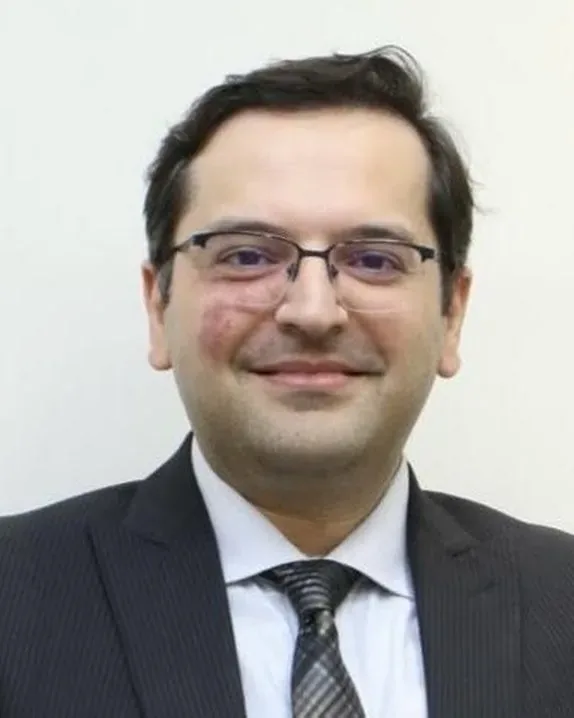
US Board Certified ERCP · EUS · Complex biliary 20+ years' experience Shifa International Hospital Invited national speaker
Dr. Maaz Bin Badshah, Consultant Gastroenterologist at Shifa International Hospital
Board certified · USA Diplomate, American Board of Internal Medicine· Diplomate, American Board of Internal Medicine – Gastroenterology Verify certification at ABIM ↗

A brief introduction

Meet Dr. Maaz

About Dr. Maaz

Care shaped by two decades of medicine, across two continents.

Dr. Maaz Bin Badshah is a consultant gastroenterologist and advanced (interventional) endoscopist with over twenty years in medicine. He trained and practised for more than a decade in the United States — internal medicine residency at Mount Sinai, New York; a faculty appointment as Assistant Professor of Medicine at Indiana University Health; a gastroenterology fellowship at the University of Illinois, Peoria; and an advanced endoscopy fellowship at NYU Long Island.

He went on to practise as an advanced GI attending at the University of Illinois, Peoria, and continues to serve part-time at Sanford Health in Bismarck, North Dakota. His focus today is Islamabad, where he cares for patients at Shifa International Hospital, serves as Assistant Professor of Gastroenterology at Shifa Tameer-e-Millat University (STMU), and is Program Director of the Gastroenterology and Advanced Endoscopy fellowship programs — training the next generation of endoscopists.

His clinical focus is advanced interventional endoscopy — particularly ERCP, endoscopic ultrasound (EUS), and complex biliary and pancreatic disease. He is board certified by the American Board of Internal Medicine in both Internal Medicine and Gastroenterology.

Nationally recognised in his field, Dr. Maaz is a regularly invited speaker at Pakistan's leading professional conferences — including those of the Pakistan Society of Gastroenterology & GI Endoscopy (PSG), the Pakistan Society of Hepatology (PSH), the Pakistan Society for the Study of Liver Diseases (PSSLD), and the Pakistan GI & Liver Diseases Society (PGLDS).

His approach is simple: explain what's happening in plain language, and choose the least invasive path that solves the problem.
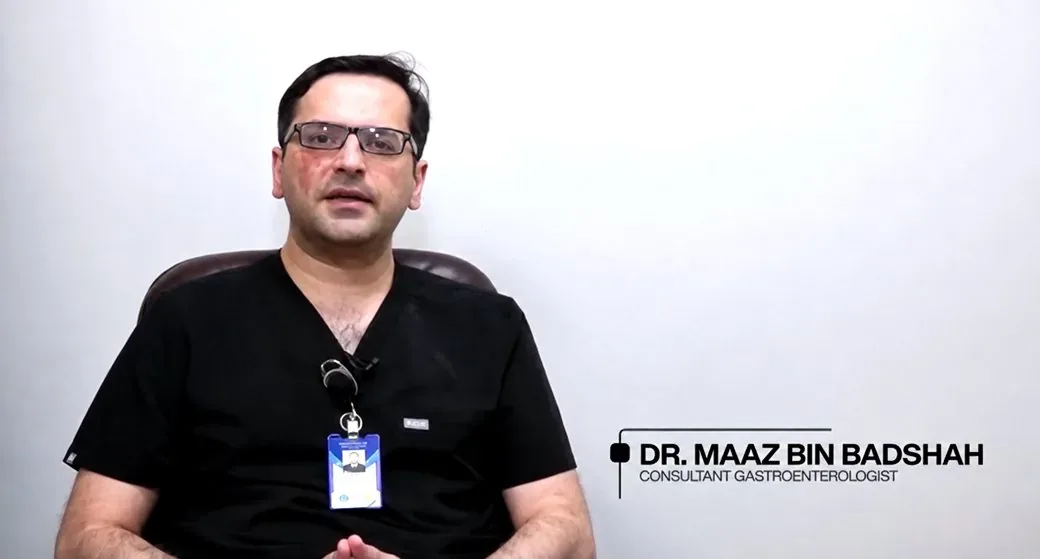
Dr. Maaz Bin Badshah, Consultant Gastroenterologist, at Shifa International Hospital
Every patient deserves to understand their own diagnosis — and to feel heard while we treat it. — Dr. Maaz Bin Badshah
LanguagesEnglish · Urdu · Pashto
My promiseI recommend only the tests and procedures you genuinely need — never more.
My approachListen first, explain in plain language, and choose the least invasive path that works.

What I treat

Conditions I care for

From everyday digestive complaints to complex liver and bile-duct disease — investigated thoroughly and treated with the latest techniques.

Acid reflux & heartburn

Persistent heartburn, regurgitation, or chest discomfort after meals (GERD).

Abdominal pain & indigestion

Ongoing stomach pain, fullness, or unexplained digestive symptoms.

IBS, bloating & bowel changes

Cramping, bloating, constipation, or diarrhoea that won't settle.

Liver disease & hepatitis

Fatty liver, hepatitis B and C, abnormal liver tests, and cirrhosis care.

Gallstones & bile-duct problems

Jaundice, gallstone pain, and blocked or narrowed bile ducts.

Difficulty swallowing

Food sticking, painful swallowing, or conditions such as achalasia.

Polyps, growths & early cancers

Removal of polyps and early tumours from the stomach or bowel wall.

Colon cancer screening

Preventive colonoscopy and screening for reassurance and peace of mind.

Digestive bleeding

Bleeding from the digestive tract, investigated and treated promptly.

Barrett's oesophagus

Monitoring and treating changes in the food-pipe lining caused by long-term reflux.

Pancreatic cysts & masses

Assessment and endoscopic management of pancreatic cysts, lesions and tumours.

Chronic pancreatitis & achalasia

Long-standing pancreas inflammation and swallowing disorders such as achalasia.

Procedures & services

Advanced diagnosis and treatment, explained simply

Many problems that once needed major surgery can now be treated through an endoscope — with less pain and a faster recovery.

Upper endoscopy

A thin, flexible camera gently examines your food pipe, stomach and upper bowel — usually in a few minutes, with sedation for comfort.

Colonoscopy

A careful camera examination of the large bowel to find and remove polyps before they can become a problem.

ERCP BILIARY

Clearing blocked or narrowed bile ducts, removing stones, and managing complex biliary and pancreatic problems with stents — avoiding open surgery.

Endoscopic ultrasound EUS

Ultrasound from inside the body to examine the pancreas, bile ducts and gut wall closely, and to take precise biopsies.

Cyst & fluid drainage EUS-GUIDED

Draining pancreatic cysts and fluid collections from inside the stomach under ultrasound guidance (cyst-gastrostomy) — avoiding open surgery or external drains.

Targeted tumour ablation EUS · RFA

Treating selected pancreatic and other lesions with precisely delivered energy (radiofrequency ablation), guided by ultrasound from within the gut.

Submucosal dissection ESD

Keyhole removal of early cancers and large growths from the gut wall — without removing the organ.

Large polyp removal EMR

Removing large or difficult colon polyps through the scope (endoscopic mucosal resection) — often avoiding the need for bowel surgery.

Control of GI bleeding ENDOSCOPIC

Stopping bleeding in the stomach and food pipe, including specialised glue injection to seal swollen, high-risk veins (varices).

POEM SWALLOWING

An incisionless treatment for swallowing disorders such as achalasia, performed entirely through an endoscope.

A special interest in complex biliary & pancreatic disease: Dr. Maaz's advanced training in ERCP and EUS means difficult bile-duct and pancreatic problems — stones, strictures, blockages and jaundice — can often be diagnosed and treated endoscopically, without surgery and closer to home. Read why this matters →

Complex biliary and pancreatic endoscopy

ERCP · EUS · Cholangioscopy · Therapeutic endoscopy
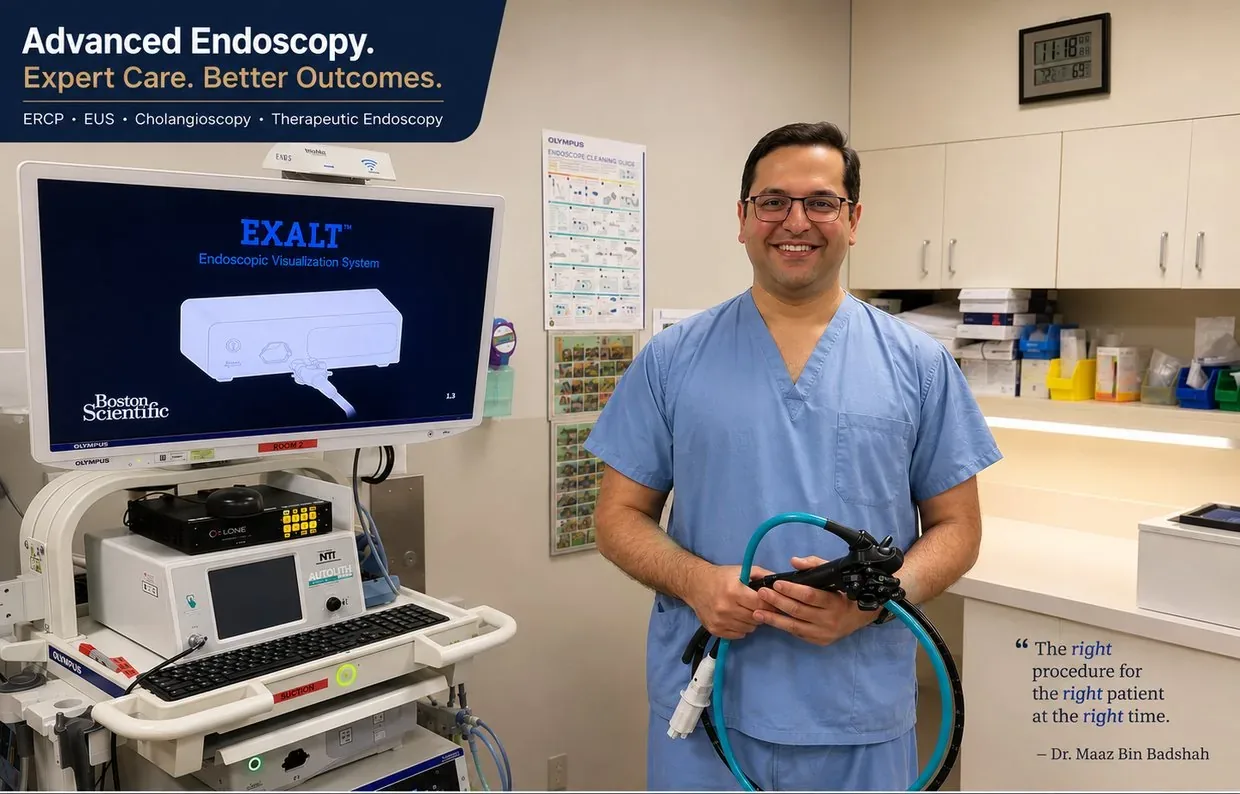
Dr. Maaz Bin Badshah, Consultant Gastroenterologist and Advanced Endoscopist, with a duodenoscope in the endoscopy suite. Advanced Endoscopy: expert care, better outcomes. ERCP, EUS, cholangioscopy and therapeutic endoscopy.

Bile duct & pancreatic disorders

  • Bile duct stones
  • Jaundice
  • Bile duct strictures
  • Bile leaks & infections
  • Pancreatitis

Advanced expertise

  • ERCP
  • EUS
  • Cholangioscopy (SpyGlass)
  • Stone fragmentation (EHL)
  • Stent placement
  • Targeted biopsies

Evidence-based care

Modern technology. International standards. Compassionate care. Better outcomes.
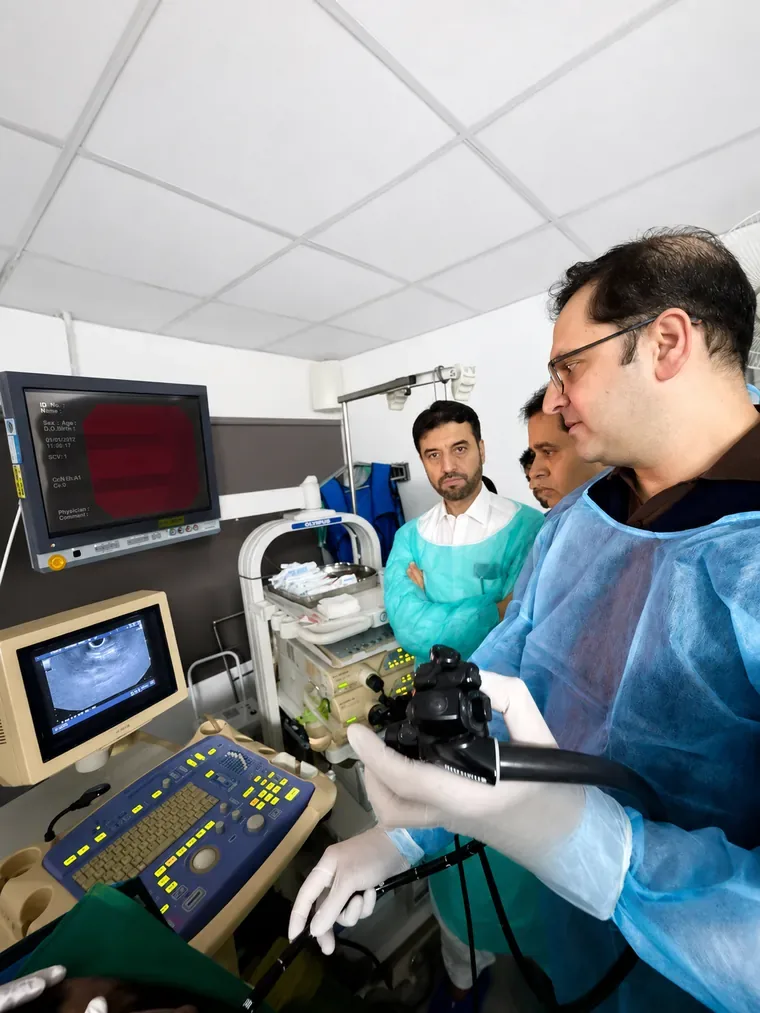
Dr. Maaz Bin Badshah holding an endoscope during a procedure
Steady hands, clear view

Research & academic work

Advancing the field, and teaching the next generation

Beyond the clinic, Dr. Maaz contributes to the evidence base in gastroenterology and endoscopy, and leads training for future specialists.

Selected publications

Surgical Endoscopy · 2026

Endoscopic versus surgical management of iatrogenic colonic perforations — a GRADE-assessed systematic review & meta-analysis (senior author)

Surgical Endoscopy · 2026

POEM versus laparoscopic Heller myotomy for achalasia — a systematic review & meta-analysis

Journal of Gastrointestinal Cancer · 2026

EUS-guided fine-needle biopsy for solid pancreatic masses — a GRADE-assessed meta-analysis

Teaching & leadership

  • Program Director — Gastroenterology & Advanced Endoscopy fellowship programs, Shifa International Hospital.
  • Assistant Professor of Gastroenterology — Shifa Tameer-e-Millat University (STMU).
  • Invited national speaker — PSG, PSH, PSSLD and PGLDS conferences.
  • Mentorship — supervising research and hands-on advanced-endoscopy training for fellows.

Interested in the fellowship or in training opportunities? Get in touch →
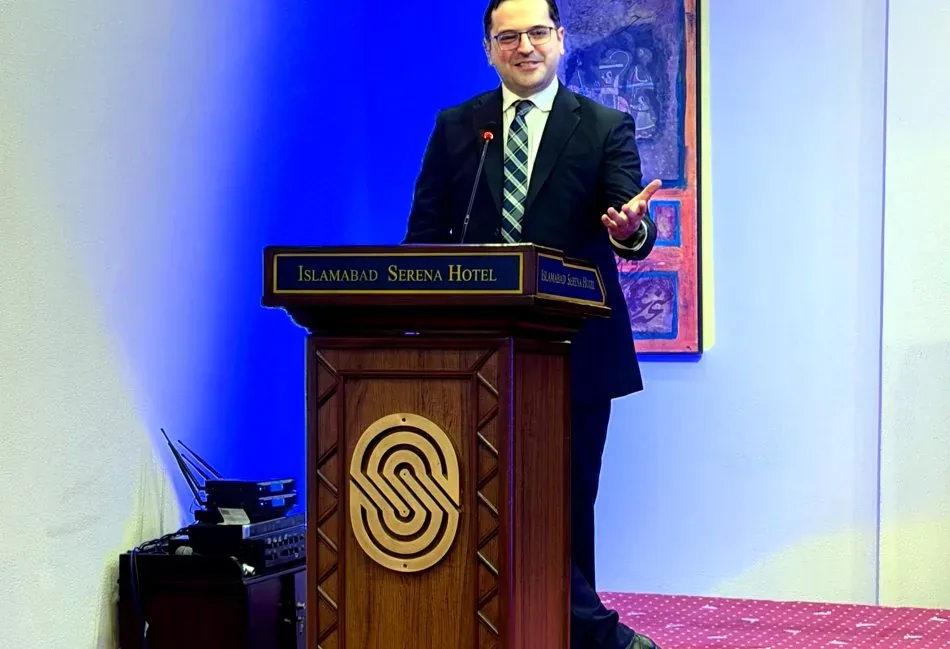
Dr. Maaz Bin Badshah speaking at a conference in Islamabad
Speaking at a conference, Islamabad
Dr. Maaz Bin Badshah presenting certificates as Program Director
Presenting certificates as Program Director

Patient education & writing

Learn, prepare, and read along

Clear guides to help you prepare for procedures and understand your condition — plus longer essays on medicine and the systems around it.

Patient guides

Procedure

Your ERCP, explained

What it is, why it's done, how to prepare, and what to expect — start to finish.

Read guide
Procedure prep

Preparing for your colonoscopy

What to eat, how the bowel prep works, and what to expect on the day.

Read guide
Procedure prep

Before your upper endoscopy

Fasting instructions, sedation, and a step-by-step of the procedure.

Read guide
Understanding

Acid reflux & GERD

Why it happens, the triggers to watch, and when heartburn needs attention.

Read guide
Understanding

Living well with IBS

Practical steps for managing bloating, cramps, and unpredictable bowels.

Read guide
Understanding

Hepatitis B & C explained

Testing, treatment, and what a diagnosis really means for daily life.

Read guide
Understanding

Understanding IBD — Crohn's & colitis

What it is, how it differs from IBS, and the warning signs that need a doctor.

Read guide
Aftercare

After your ERCP

Recovering safely, what's normal, and the warning signs to act on.

Read guide
Diet

The low-FODMAP diet, with local foods

A practical, Pakistani-foods guide to easing IBS bloating, wind and cramps.

Read guide
Diet

Eating to ease reflux (GERD)

Which everyday foods trigger heartburn — and what to reach for instead.

Read guide
Diet

The fatty liver diet

What to cut and what to eat to help reverse fatty liver disease.

Read guide
اردو

فیٹی لیور کے لیے خوراک

جگر کی چربی کم کرنے کے لیے کیا کھائیں اور کن چیزوں سے پرہیز کریں۔

پڑھیں
اردو

ای آر سی پی — مکمل رہنمائی

یہ کیا ہے، کیوں کی جاتی ہے، تیاری کیسے کریں، اور کیا توقع رکھیں۔

پڑھیں
اردو

کالونوسکوپی کی تیاری

اپنے ٹیسٹ کو محفوظ، جلد اور درست بنانے کے لیے تیاری کیسے کریں۔

پڑھیں
اردو

اپر اینڈوسکوپی سے پہلے

معدے کی اینڈوسکوپی کی تیاری اور دن بھر کیا ہوتا ہے۔

پڑھیں
اردو

معدے کی تیزابیت اور ریفلکس

علامات، وجوہات، اور سینے کی جلن سے آرام کے لیے کیا کریں۔

پڑھیں
اردو

آئی بی ایس کے ساتھ بہتر زندگی

آنتوں کی حساسیت کو سمجھیں اور علامات پر قابو پائیں۔

پڑھیں
اردو

ہیپاٹائٹس بی اور سی

یہ کیسے پھیلتے ہیں، ٹیسٹ کیوں ضروری ہے، اور علاج کیا ہے۔

پڑھیں
اردو

ای آر سی پی کے بعد

محفوظ صحتیابی، کیا نارمل ہے، اور کن علامات پر فوراً رجوع کریں۔

پڑھیں
اردو

لو-فوڈمیپ خوراک، مقامی کھانوں کے ساتھ

آئی بی ایس کی سوجن، گیس اور مروڑ کم کرنے کے لیے عملی رہنمائی۔

پڑھیں
اردو

ریفلکس کم کرنے کے لیے خوراک

کون سے روزمرہ کھانے سینے کی جلن بڑھاتے ہیں — اور اُن کی جگہ کیا کھائیں۔

پڑھیں

Watch — patient videos

From my desk

The Long Arc

Longer-form essays and reflections — on medicine and its institutions, how systems shape the care patients actually receive, and the long view of a life spent in practice. Less clinic, more thinking aloud.

Medical systemsEndoscopy & innovationTraining & reformEssays
Read all essays on Substack

Latest essays

Loading the latest from The Long Arc… Read on Substack →

Patient reviews

What patients say

Five-star rated by patients on Google

Prevention

Colorectal cancer is preventable — and screening now starts at 45.

Most colon cancers begin as polyps that can be found and removed during a colonoscopy, long before they become dangerous. If you're 45 or older, or have a family history or symptoms, a screening could save your life.

Planning your care

For patients & referring doctors

Whether you're coming in for the first time, referring a patient, or seeking an expert opinion from afar — here's how it works.

Your first visit

Please bring any previous reports, scans, endoscopy results, and a list of your current medicines. Arrive a little early to register. Consultations are unhurried — come with your questions written down.

Referring a patient

Colleagues are welcome to refer patients for advanced endoscopy — ERCP, EUS, ESD, complex polyps and biliary or pancreatic problems. Send clinical details and relevant imaging via the clinic, and the team will arrange timely review.

Second opinion & overseas

Away from Islamabad, or seeking care for family in Pakistan? Dr. Maaz reviews reports and offers expert second opinions remotely. Reach out the same way — by phone or WhatsApp — and the team will guide you.

Questions

Frequently asked questions

Quick answers to what patients most often ask before their visit.

How do I book an appointment with Dr. Maaz?

You can book through Shifa International Hospital's Find a Doctor page, or by calling the clinic on +92 51 8464646. Clinic hours are Monday to Friday, 9:00 AM to 4:00 PM.

What should I bring to my first visit?

Please bring any previous reports, scans, and endoscopy results, along with a list of your current medicines. Arriving a little early to register helps your consultation start on time.

Can I get a second opinion from another city or from overseas?

Yes. Dr. Maaz reviews reports and offers expert second opinions for patients outside Islamabad, including families seeking care for relatives in Pakistan. Reach out by phone or WhatsApp and the team will guide you on next steps.

How do I get my report or follow up after a procedure?

For reports and follow-up questions, you can message the clinic on WhatsApp at +92 345 9116675. Please note this number is for reports and follow-ups — new appointments are booked by phone or through Shifa's Find a Doctor page.

What languages does Dr. Maaz speak?

Dr. Maaz consults comfortably in English, Urdu and Pashto.

What does Dr. Maaz specialise in?

He is an advanced (interventional) endoscopist with particular expertise in ERCP, endoscopic ultrasound (EUS), ESD, complex polyp removal and POEM — and in complex biliary and pancreatic disease that can often be treated without surgery.

Appointments

Visit Dr. Maaz

Book a consultation in person at Shifa International Hospital, or reach out with a question.

Where to find me

Clinic
Gastroenterology Clinic 1, Level D-0
Shifa International Hospital, Pitras Bukhari Road, H-8/4, Islamabad
Clinic hours
Monday–Friday, 9:00 AM – 4:00 PM
(by appointment)

Book your appointment

Appointments are booked by phone or through Shifa.com.pk. WhatsApp is for existing patients' reports and follow-ups. For emergencies or urgent symptoms, please contact Shifa International Hospital directly or go to your nearest emergency department.

Patient guide · Procedure prep

Preparing for your colonoscopy

A colonoscopy is one of the best ways to check the health of your large bowel and to find and remove polyps before they can cause harm. Good preparation makes the test safer, quicker, and more accurate — here's exactly what to do.

What a colonoscopy is

A thin, flexible tube with a small camera is passed gently through the back passage to examine the entire large bowel (colon). You'll usually be given sedation so you're relaxed and comfortable. If any polyps are found, they can often be removed during the same procedure. The examination itself typically takes 20–45 minutes.

Why the preparation matters

The bowel must be completely clean for the camera to see clearly. If preparation is incomplete, small polyps can be missed — and occasionally the test has to be repeated. The effort you put into the prep directly affects how good and how safe your colonoscopy is.

A few days before

  • Switch to a low-fibre diet for about 3 days before: avoid whole grains, nuts, seeds, raw vegetables, salads, sweetcorn, and fruit skins. White bread, white rice, plain pasta, eggs, chicken and fish are fine.
  • Tell the clinic about your medicines. Blood thinners (such as warfarin, aspirin, clopidogrel, or newer agents), diabetes medicines and insulin, and iron tablets may need adjusting or pausing. Never stop a prescribed medicine without checking first.
  • Stop iron supplements about 5 days before, as they darken and coat the bowel lining.
  • Arrange an escort. Because of the sedation, you must have a responsible adult to take you home. You cannot drive for the rest of the day.
Your exact bowel-prep instructions

Your specific bowel-cleansing medicine, dose, and timing will be given to you by the clinic when your colonoscopy is booked. Follow those instructions precisely — they are matched to your appointment time. The steps below explain the general pattern.

The day before

  1. Clear liquids only from the morning: water, clear broth, apple juice, green tea, clear soft drinks.
  2. Avoid anything red or purple in colour, as it can look like blood inside the bowel.
  3. Take your bowel-prep solution at the times given. Frequent, watery motions for several hours are normal — that's the prep working.
  4. Keep drinking clear fluids to stay hydrated, and stay near a toilet during this time.

Your motions should gradually become clear or pale yellow, like tea without milk — the sign you're well prepared.

The day of your colonoscopy

  • Follow the fasting instructions you were given — usually clear fluids up to a few hours before, then nothing.
  • Wear loose, comfortable clothing and bring your medicine list and previous reports.
  • Leave jewellery and valuables at home.
When to call before your test

Contact the clinic beforehand if you have significant heart, kidney or liver disease, if you are diabetic, if you might be pregnant, or if you have ever reacted to sedation. These aren't reasons to cancel — just things we plan around to keep you safe.

Frequently asked questions

Is a colonoscopy painful?

Most people feel little or no pain. Sedation keeps you relaxed and drowsy, and many remember very little afterwards. Some bloating or cramping from the air used settles quickly.

Can I take my regular medicines?

Most can be continued, but blood thinners, diabetes medicines and iron often need adjusting. Confirm with the clinic in advance rather than stopping anything yourself.

What if the prep makes me feel sick?

Some nausea is common. Slow down, take smaller sips, and take short breaks. If you vomit repeatedly or can't keep it down, contact the clinic.

How long until I get results?

Dr. Maaz usually explains the main findings straight after, once the sedation wears off enough to talk. Biopsy results follow in a few days.

Questions about your colonoscopy?

The clinic team is happy to help you prepare with confidence.

This guide provides general information only and does not replace personal medical advice. Always follow the specific instructions given to you by Dr. Maaz and the clinic. For emergencies, contact Shifa International Hospital or your nearest emergency department.

Patient guide · Procedure prep

Before your upper endoscopy

An upper endoscopy — also called a gastroscopy — lets Dr. Maaz look directly at your food pipe, stomach, and the first part of the small bowel. It's a short, safe procedure, and preparing well makes it quick and comfortable.

What an upper endoscopy is

A thin, flexible tube with a tiny camera is passed gently through your mouth to examine the oesophagus (food pipe), stomach, and duodenum. It helps find the cause of heartburn, difficulty swallowing, indigestion, or bleeding, and allows painless biopsies. It usually takes only 5–15 minutes.

The single most important rule

Your stomach must be empty. Following the fasting instructions carefully keeps the procedure safe and lets Dr. Maaz see everything clearly.

Fasting — the day of your test

  • No food for at least 6 hours before your appointment.
  • Clear fluids (water) may usually be taken up to about 2 hours before — follow the exact timing the clinic gives you.
  • Then nothing at all by mouth until after the procedure.
Confirm your exact timings

The clinic will give you precise fasting times based on your appointment slot. If anything here differs from what you were told, follow the clinic's instructions.

Your medicines

  • Blood thinners may need adjusting — check in advance, especially if biopsies or treatment are planned.
  • Diabetes medicines and insulin usually need adjusting on the day because you'll be fasting.
  • Acid-reducing medicines (PPIs) may sometimes be paused beforehand — you'll be told if this applies.
  • Most other medicines can be taken with a small sip of water unless told otherwise.

On the day

  1. Arrange a responsible adult to take you home if you're having sedation — you can't drive afterwards.
  2. Wear comfortable clothing; remove lipstick and, if asked, dentures beforehand.
  3. Bring your medicine list and any previous reports or scans.
  4. You'll be offered a numbing throat spray (awake) or sedation (relaxed and drowsy). Dr. Maaz will discuss which suits you.
After sedation

For the rest of the day, don't drive, operate machinery, sign important documents, or drink alcohol. Have someone with you at home if possible.

Frequently asked questions

Will I be able to breathe with the tube in?

Yes. The tube goes down the food pipe, not the windpipe, so breathing is unaffected. Your oxygen is monitored throughout.

Does it hurt?

It shouldn't. With throat spray you may feel some pressure; with sedation most people remember little. Relaxing and breathing slowly minimises gagging.

Can I have it without sedation?

Yes — many choose throat spray alone, which means no recovery time and you can drive home. Dr. Maaz will help you decide.

When can I eat afterwards?

Usually about an hour later, once any throat numbness has fully worn off. Start with something soft and cool.

Questions before your endoscopy?

The clinic team is happy to guide you through it.

This guide provides general information only and does not replace personal medical advice. Always follow the specific instructions given to you by Dr. Maaz and the clinic. For emergencies, contact Shifa International Hospital or your nearest emergency department.

Patient guide · Understanding

Acid reflux & GERD

Almost everyone has heartburn now and then. But when reflux happens often and starts affecting daily life, it may be gastro-oesophageal reflux disease (GERD) — a common and very treatable condition.

What is happening

A muscular valve sits between your food pipe and stomach, normally keeping acid where it belongs. In reflux, this valve relaxes at the wrong times, letting stomach acid flow back up. Because the food pipe isn't built for acid, this causes the familiar burning discomfort.

Common symptoms

  • A burning feeling in the chest, often after meals or lying down (heartburn)
  • A sour or bitter taste, or food coming back up into the throat
  • Discomfort that's worse at night or when bending over
  • A persistent cough, hoarseness, or the feeling of a lump in the throat
  • Bloating, frequent burping, or nausea

What makes it worse

  • Large or late meals, especially within 3 hours of lying down
  • Trigger foods: fried and fatty food, spicy dishes, chocolate, mint, citrus, tomatoes, coffee and fizzy drinks
  • Extra weight around the middle, which presses on the stomach
  • Smoking and alcohol
  • Stress, which heightens how strongly you feel symptoms

Steps that genuinely help

  1. Eat smaller meals, and finish eating at least 3 hours before bed.
  2. Raise the head of your bed by about 15 cm (blocks under the legs, not just pillows).
  3. Identify and cut back your personal trigger foods — keep a diary for two weeks.
  4. If you carry extra weight, even modest loss markedly reduces reflux.
  5. Stop smoking and reduce alcohol.
  6. Avoid tight clothing around the waist.
About acid-reducing medicines

Antacids soothe occasional symptoms. For persistent reflux, medicines called PPIs reduce acid and let the food pipe heal. They're effective but work best alongside the lifestyle steps above — and ongoing use should be reviewed with a doctor rather than continued indefinitely on your own.

See a specialist promptly if you have any of these

Difficulty or pain swallowing, food sticking, unintended weight loss, vomiting, black or bloody stools, vomiting blood, or anaemia. These "alarm" symptoms need assessment — often with an endoscopy. New heartburn after age 50 also deserves a proper check.

How Dr. Maaz can help

If reflux is frequent, not responding to treatment, or you have alarm symptoms, an upper endoscopy allows a direct look to confirm the diagnosis, check for complications, and rule out other causes. Treatment is then tailored to you — and in selected cases, endoscopic or surgical options exist for reflux that won't settle with medicines.

Frequently asked questions

Is heartburn ever a heart problem?

Reflux and heart pain can feel similar. If chest pain is severe, spreads to the arm or jaw, or comes with sweating or breathlessness, treat it as an emergency and seek urgent care immediately.

Do I have to take medicine forever?

Not necessarily. Many improve enough with lifestyle changes to reduce or stop medicines. The goal is the lowest treatment that keeps you comfortable, reviewed with your doctor.

Can reflux cause damage over time?

Long-standing, untreated reflux can change the lining of the food pipe in a small number of people — which is exactly why persistent symptoms are worth assessing.

Reflux that won't settle?

Persistent heartburn is worth getting to the bottom of.

This guide provides general information only and does not replace personal medical advice. If symptoms are severe or persistent, please seek a consultation. For emergencies, contact Shifa International Hospital or your nearest emergency department.

Patient guide · Understanding

Living well with IBS

Irritable bowel syndrome is one of the most common digestive conditions in the world. It's real, it's manageable, and it doesn't damage the bowel — but it can genuinely affect quality of life. Here's how to take back control.

What IBS is — and isn't

IBS is a disorder of how the gut and brain communicate. The bowel becomes over-sensitive and its movements irregular, producing symptoms — but there's no ulcer, inflammation or damage on tests. That's reassuring: IBS does not turn into cancer and does not shorten life. It can, however, be uncomfortable and unpredictable, and deserves proper management.

Common symptoms

  • Cramping or abdominal pain, often relieved by opening the bowels
  • Bloating and a feeling of fullness or trapped wind
  • Diarrhoea, constipation, or an alternating pattern of both
  • A sense of not fully emptying, or urgency
  • Symptoms that flare with stress or after certain meals

Common triggers

  • Certain foods — often those high in "FODMAPs" (see below)
  • Stress and anxiety, which the gut is highly sensitive to
  • Irregular eating, skipped meals, or eating very quickly
  • Caffeine, fizzy drinks and alcohol
  • Poor sleep and lack of routine

Everyday steps that help

  1. Eat regular meals at a relaxed pace; don't skip meals or eat very late.
  2. Keep a food-and-symptom diary for two to three weeks to spot your triggers.
  3. Stay hydrated with water; limit caffeine and fizzy drinks.
  4. Get moving — regular gentle exercise like walking genuinely eases IBS.
  5. Protect your sleep and build in ways to lower stress.
  6. For constipation, gradually increase soluble fibre (oats, psyllium) rather than sudden large amounts.
The low-FODMAP approach

FODMAPs are certain sugars in foods like onion, garlic, wheat, some fruits, beans and milk that can ferment and trigger symptoms. A structured low-FODMAP plan — ideally with a dietitian — removes them for a few weeks, then carefully reintroduces them to find your tolerances. It's meant to be temporary and personalised, not a permanent restriction.

These symptoms are NOT typical IBS — see a doctor

Bleeding or black stools, unintended weight loss, fever, waking at night with pain or diarrhoea, a family history of bowel cancer or inflammatory bowel disease, anaemia, or new symptoms after age 50. These "red flags" need assessment to rule out other conditions.

How Dr. Maaz can help

A confident IBS diagnosis comes from recognising the typical pattern and, where needed, simple tests to exclude other causes such as coeliac disease, inflammation, or infection. Treatment is then tailored to your main symptom — pain, bloating, constipation or diarrhoea — combining dietary guidance, targeted medicines, and strategies for the gut–brain connection. Most people improve significantly.

Frequently asked questions

Is IBS all in my head?

No. The symptoms are physically real. The gut and brain are closely wired, so stress can amplify symptoms — but that doesn't make them imaginary, and effective treatments exist.

Will I need a colonoscopy?

Not always. It's recommended when there are red-flag symptoms, a relevant family history, or when the picture isn't clearly IBS — to make sure nothing else is missed.

Can IBS be cured?

It tends to come and go over life rather than disappear, but symptoms can be very well controlled — many become largely symptom-free with the right plan.

Struggling with unpredictable symptoms?

A clear plan makes a real difference.

This guide provides general information only and does not replace personal medical advice. If you have red-flag symptoms or ongoing difficulty, please seek a consultation. For emergencies, contact Shifa International Hospital or your nearest emergency department.

Patient guide · Understanding

Hepatitis B & C explained

Hepatitis B and C are common in Pakistan, and many people carry them for years without knowing. The most important message is hopeful: hepatitis C is now curable in most people, and hepatitis B is very manageable — but only once it's found. Testing is everything.

What they are

Hepatitis B and C are viruses that infect the liver. In many people the infection becomes long-standing (chronic), causing slow, silent inflammation. Over years, untreated infection can scar the liver (cirrhosis) and raise the risk of liver cancer. Caught early and managed well, most of that harm is preventable.

How they spread

  • Blood contact — reused or unsterile needles and syringes, unsafe injections, shared razors or blades
  • Medical or dental procedures with improperly sterilised instruments
  • Unscreened blood transfusions (now rare where blood is properly screened)
  • Mother to baby at birth (mainly hepatitis B)
  • Unprotected sex (mainly hepatitis B)

They are not spread by sharing food or water, hugging, or everyday contact.

Why testing matters so much

Both infections are usually silent for years — you can feel completely well while the liver is quietly affected. A simple blood test detects them. If you've ever had an unscreened transfusion, unsterile injection or dental work, a shared razor, or a family member with hepatitis, getting tested is one of the most valuable things you can do.

Symptoms — often none, but watch for

  • Unusual tiredness
  • Yellowing of the eyes or skin (jaundice)
  • Dark urine or pale stools
  • Pain over the right upper abdomen
  • Nausea or loss of appetite

The good news about treatment

Hepatitis C

Modern tablets (direct-acting antivirals) cure hepatitis C in the great majority of people, usually within 8–12 weeks, with very few side effects — one of the real success stories of modern medicine.

Hepatitis B

Hepatitis B usually can't be "cured" in the same way, but it's very controllable. Many people simply need monitoring; others benefit from safe, effective long-term medicines that suppress the virus. Crucially, a vaccine prevents hepatitis B entirely — and family members should be tested and vaccinated.

If you already have a diagnosis

Please don't ignore it, even if you feel fine. Regular monitoring protects your liver, guides treatment timing, and screens for complications early. Avoid alcohol, be cautious with over-the-counter and herbal remedies that can stress the liver, and keep your follow-up appointments.

How Dr. Maaz can help

Care includes confirming the diagnosis, assessing how active the infection is and whether the liver is affected, deciding if and when treatment is needed, and arranging cure or long-term control — guiding you through the antiviral course for hepatitis C, or tailored monitoring and family protection for hepatitis B.

Frequently asked questions

Is hepatitis C really curable?

Yes. For most people, a short course of well-tolerated tablets clears the virus completely. The main barrier now is simply getting tested and starting treatment.

Can I pass it to my family?

Everyday contact like sharing meals is safe. The risks relate to blood and, for hepatitis B, birth and sexual contact. Family testing and — for hepatitis B — vaccination are the key protections.

I feel fine. Do I still need treatment?

Feeling well doesn't mean the liver is unaffected. That's why assessment and monitoring matter even without symptoms — it lets us act before problems develop.

Get tested, get peace of mind

Whether it's screening or managing a known diagnosis, Dr. Maaz can help.

This guide provides general information only and does not replace personal medical advice, testing, or treatment. For emergencies, contact Shifa International Hospital or your nearest emergency department.

Patient guide · Aftercare

After your ERCP

ERCP is an advanced procedure used to treat problems in the bile ducts and pancreas — clearing stones, relieving blockages, and placing stents without open surgery. Most people recover smoothly. This guide explains what's normal, and the warning signs that need prompt attention.

What was done

During ERCP, a specialised endoscope was guided to where the bile duct and pancreatic duct drain into the bowel. Using X-ray guidance, Dr. Maaz diagnosed and treated the problem — for example removing a stone, opening a narrowing, or placing a small tube (stent) to keep the duct draining. Dr. Maaz will have explained what was found and done in your case.

What's normal in the first day or two

  • A mildly sore throat from the endoscope
  • Some bloating or wind from the air used
  • Feeling tired or drowsy from the sedation for the rest of the day
  • Mild, settling discomfort in the upper abdomen

Looking after yourself at home

  1. Rest for the remainder of the day. Because of sedation, don't drive, operate machinery, sign documents or drink alcohol for 24 hours, and have someone with you if possible.
  2. Start eating gently once allowed and ready — light, low-fat food and clear fluids, then build up.
  3. Take your medicines as advised, including any specific instructions about blood thinners.
  4. Stay hydrated and avoid heavy, greasy meals on the first day.
  5. Keep your follow-up appointment — especially important if a stent was placed, as some need changing or removing later.
⚠ Seek urgent medical care if you develop any of these

ERCP is generally safe, but complications can occur and are treatable when acted on early. Contact the clinic or go to the nearest emergency department right away if you have:

Severe or worsening tummy pain, especially with nausea or vomiting (can signal pancreas inflammation)
Fever or chills (possible bile-duct infection)
Yellowing of the eyes or skin, or dark urine returning
Vomiting blood, or black, tarry stools (possible bleeding)
Difficulty breathing, chest pain, or a hard, swollen abdomen

Don't wait to see if it passes — these are the signs we specifically want to catch early.

Your after-hours contact

For anything urgent, call the clinic on +92 51 8464646 or attend the Shifa International Hospital emergency department. If you were given a specific after-hours or ward number, use that.

If a stent was placed

Stents are commonly used to keep a duct open. Some are temporary and planned for removal or exchange after a set time; others may pass on their own. It's important you understand your specific plan — if unsure whether or when your stent needs attention, contact the clinic. A stent left in too long can block and cause infection, so the follow-up genuinely matters.

Frequently asked questions

How long until I feel normal?

Most people feel much better within a day or two. Tiredness from sedation passes quickly, and any sore throat settles within a couple of days.

When can I return to work?

Many return the next day, though it depends on what was done and how you feel. Avoid anything strenuous on the day itself because of the sedation.

Is some discomfort expected?

Mild, settling upper-abdominal discomfort and bloating can be normal. What is not normal is severe or worsening pain, fever, or vomiting — those need urgent review as above.

Concerned after your procedure?

Don't hesitate to reach out — early advice is always better.

This guide provides general information only and does not replace personal medical advice. Always follow the specific instructions given to you by Dr. Maaz and the clinic. In an emergency, or for any of the warning signs above, contact Shifa International Hospital or your nearest emergency department without delay.

Special interest

Complex biliary & pancreatic endoscopy — and why it matters

Some of the most difficult problems in gastroenterology involve the bile ducts and pancreas. Advanced (interventional) endoscopy now lets many of them be treated through a scope — safely, precisely, and without open surgery. This is Dr. Maaz's core area of expertise.

What "advanced" endoscopy means

Beyond routine endoscopy and colonoscopy lies a smaller set of highly specialised techniques — ERCP, endoscopic ultrasound (EUS), and their therapeutic uses — that require dedicated advanced fellowship training and high case volumes to perform safely. Relatively few gastroenterologists are trained in them. They are what allow bile-duct and pancreatic disease to be managed without surgery.

ERCP — treating the bile ducts from within

ERCP reaches the point where the bile duct and pancreatic duct drain into the bowel. Through it, Dr. Maaz can remove bile-duct stones, open blockages and narrowings, relieve jaundice, and place stents to keep ducts draining — problems that once required major surgery, now solved endoscopically in most cases.

EUS — seeing, sampling, and treating

Endoscopic ultrasound places a tiny ultrasound probe right next to the pancreas and bile ducts. It gives extraordinarily detailed images, allows precise needle biopsies of pancreatic masses, and — in expert hands — enables treatments such as draining fluid collections and cysts, and targeted ablation of certain lesions.

Why it matters for you

The right advanced procedure at the right time can mean avoiding open surgery, a shorter recovery, fewer complications, and answers reached faster. For complex biliary and pancreatic problems, being seen by a high-volume advanced endoscopist genuinely changes outcomes.

When to seek an advanced endoscopist

  • Jaundice, or a bile duct blocked by stones or a narrowing
  • A pancreatic mass, cyst, or unexplained pancreatic finding on a scan
  • Recurrent or complicated pancreatitis
  • A large or difficult polyp, or an early cancer, that another endoscopist felt unable to remove
  • Any problem where you've been told surgery may be the only option — a second, endoscopic opinion is often worthwhile
Not sure if this applies to you?

If you have reports or scans and aren't sure whether an endoscopic option exists, the clinic is happy to review them. Reach out by phone or WhatsApp.

Have a complex biliary or pancreatic problem?

Dr. Maaz welcomes complex referrals and second opinions.

This page provides general information only and does not replace personal medical advice. For emergencies, contact Shifa International Hospital or your nearest emergency department.

Back
M

Dr. Maaz Bin Badshah

Consultant Gastroenterologist & Advanced Endoscopist · Shifa International Hospital, Islamabad

Summary

US board-certified consultant gastroenterologist and advanced (interventional) endoscopist with over twenty years in medicine, specialising in ERCP, EUS and complex biliary and pancreatic disease.

Board certification

Board certified by the American Board of Internal Medicine — in Internal Medicine and Gastroenterology

Training

  • Internal medicine residency — Mount Sinai, New York
  • Assistant Professor of Medicine — Indiana University Health
  • Gastroenterology fellowship — University of Illinois, Peoria
  • Advanced endoscopy fellowship — NYU Long Island

Current roles

  • Consultant Gastroenterologist & Advanced Endoscopist — Shifa International Hospital, Islamabad
  • Assistant Professor of Gastroenterology — Shifa Tameer-e-Millat University (STMU)
  • Program Director — GI & Advanced Endoscopy fellowship programs
  • Advanced GI attending (part-time) — Sanford Health, Bismarck, ND, USA

Clinical focus

ERCP · Endoscopic ultrasound (EUS) · ESD · EUS-guided cyst drainage & RFA · complex EMR · POEM · management of complex biliary and pancreatic disease.

Academic

Invited national speaker (PSG, PSH, PSSLD, PGLDS). Published meta-analyses in Surgical Endoscopy and the Journal of Gastrointestinal Cancer. ORCID 0000-0003-0756-0126.

Contact

Phone: +92 51 8464646 · WhatsApp (reports & follow-ups): +92 345 9116675 · Email: maaz.badshah@shifa.com.pk · Web: drmaazbinbadshah.com

Patient guide · Condition

Understanding IBD — Crohn's & ulcerative colitis

Inflammatory bowel disease (IBD) is a long-term condition where the body's own immune system inflames the gut. It's serious, but it's also very treatable — and the people who do best are the ones who understand it early and stay in proper care. If you or someone in your family has been diagnosed, or you're worried about ongoing gut symptoms, this guide explains what IBD is, what it isn't, and what to do.

What IBD actually is

IBD means the lining of your digestive tract becomes inflamed and, over time, damaged — not because of an infection you'll get over, but because the immune system is switched on when it shouldn't be. It tends to come in flares (active periods) and remission (quiet periods). It is a lifelong condition, but with the right treatment most people live full, normal, productive lives.

There are two main types:

  • Ulcerative colitis (UC) — inflammation limited to the large bowel (colon and rectum), in a continuous stretch. The most typical symptom is diarrhoea with blood.
  • Crohn's disease — can affect any part of the digestive tract, from mouth to anus, often in patches. It can go deeper into the bowel wall and cause complications like narrowing or fistulas.

Your specialist will work out which one you have, because it affects treatment.

The most important distinction: IBD is not IBS

People constantly confuse these because the names sound alike, but they're completely different. IBS (irritable bowel syndrome) is a problem of how the gut works — it's real and uncomfortable, but there's no inflammation, no bleeding, and no damage. IBD is actual inflammation and injury to the bowel that can be seen and needs medical treatment. Warning signs that point to IBD rather than IBS include blood in the stool, weight loss, anaemia, fever, and being woken from sleep by diarrhoea or pain — these are never "just IBS" and must be checked.

Common symptoms

  • Diarrhoea that lasts weeks, sometimes with blood or mucus
  • Cramping abdominal pain
  • An urgent need to pass stool, or feeling not fully emptied
  • Unintended weight loss and loss of appetite
  • Tiredness and, sometimes, anaemia (low blood)
  • Fever during flares
  • Crohn's specifically can cause mouth ulcers and problems around the anus

IBD can also affect areas outside the gut — the joints, eyes, and skin — which surprises many patients. Mention these to your doctor, as they're part of the same disease.

See a doctor promptly if you have

Blood in your stool, ongoing diarrhoea for more than a couple of weeks, unexplained weight loss, waking at night with diarrhoea or pain, fever, or severe abdominal pain. These deserve proper assessment — don't wait them out, and don't assume they're piles or a simple infection.

How IBD is diagnosed

There's no single test — diagnosis puts a few pieces together:

  • Colonoscopy with biopsies is the key test. It lets your doctor see the inflammation directly and take tiny samples to confirm it. See the colonoscopy preparation guide →
  • Blood tests for inflammation and anaemia.
  • Stool tests, including one called faecal calprotectin that flags bowel inflammation.
  • Imaging (MRI or CT) when the small bowel needs to be assessed, especially in Crohn's.
A note that matters especially here in Pakistan

Intestinal tuberculosis is common in our region and can look almost identical to Crohn's disease — same symptoms, similar appearance. Telling them apart is genuinely important, because the treatments are completely different. This is one reason IBD in Pakistan should be diagnosed carefully by a specialist, not labelled from symptoms alone. Diagnosis here is often delayed or mistaken for a simple infection or IBS — and early, correct diagnosis makes a real difference to how well you do.

The good news: IBD is treatable

This is the part patients most need to hear. IBD cannot usually be "cured," but it can very often be controlled — brought into remission and kept there. Modern treatment aims to calm the inflammation, heal the bowel lining, and keep you feeling well long-term. The right plan depends on your type, severity, and how you respond, and your specialist will tailor it to you. Many people, once settled on the right treatment, live essentially normal lives.

The single most common reason people relapse: stopping treatment when they feel well

When a flare settles, it's tempting to stop your medicines. This is one of the biggest mistakes in IBD. The treatment is often what's keeping you well — much of it works quietly in the background to prevent the next flare and protect your bowel from long-term damage. Never stop or change IBD treatment on your own; if you want to reduce it, that's a conversation with your doctor.

A careful word on diet

Unlike some gut conditions, IBD has no single proven "diet cure." Food doesn't cause IBD, and no diet replaces medical treatment. That said, a few honest points:

  • During a flare, some people find certain foods (very high-fibre, very fatty, or very spicy) harder to tolerate — but this varies person to person.
  • Good nutrition genuinely matters, because IBD can cause weight loss and deficiencies. Don't over-restrict your diet out of fear; that can do more harm than good.
  • If diet feels overwhelming, ask for a referral to a dietitian rather than following internet elimination diets.

Living well with IBD

  • Take your treatment consistently, even in remission.
  • Keep your follow-up appointments and monitoring — including any recommended surveillance colonoscopies, as long-standing colitis can raise bowel-cancer risk over many years.
  • Don't smoke — it specifically worsens Crohn's disease.
  • Tell your doctor early if symptoms return, rather than waiting for a full flare.

Frequently asked questions

Is IBD the same as IBS?

No — and this matters. IBS is a problem of gut function with no inflammation or damage. IBD is genuine inflammation that injures the bowel and needs medical treatment. Blood in the stool, weight loss, or anaemia point to IBD, not IBS.

Can IBD be cured?

Usually not cured, but very often controlled — many people reach lasting remission and feel completely well. Surgery helps some patients, particularly in UC, where removing the colon can be curative.

Will I need surgery?

Not necessarily. Many people are managed with medicines alone. Surgery is an option when it's needed, not an inevitability.

Can I have a normal life — work, marriage, children?

Yes. Well-controlled IBD is compatible with a full life, including pregnancy — which is best planned with your doctor during a period of remission.

Worried about ongoing gut symptoms, or newly diagnosed with IBD?

Getting the diagnosis right and the treatment steady is exactly where a specialist matters most.

This guide provides general information only and does not replace personal medical advice. IBD needs specialist diagnosis and ongoing care — please don't self-diagnose or change treatment based on this guide alone. For emergencies, contact Shifa International Hospital or your nearest emergency department.

Patient guide · Procedure

Your ERCP, explained

An ERCP is one of the most powerful tools we have in gastroenterology — it lets us treat problems in the bile ducts and pancreas through an endoscope, often solving something that once needed major surgery. If a doctor has recommended one, this guide walks you through exactly what it means, why it's done, and what to expect — the same explanation Dr. Maaz gives his own patients before their procedure.

What ERCP actually is

ERCP stands for Endoscopic Retrograde Cholangiopancreatography — a long name for an elegant idea. A thin, flexible camera (an endoscope) is passed gently through your mouth, down the food pipe and stomach, to the point where the bile duct and pancreatic duct drain into the small bowel. Using live X-ray pictures and a fine dye, Dr. Maaz can then see inside those ducts and, in the same sitting, treat what's wrong — remove a stone, open a blockage, relieve jaundice, or place a small tube (a stent) to keep a duct draining.

The key thing to understand: ERCP is usually a treatment, not just a test. Most people come to it because something needs fixing, and it can be fixed without a single cut on the outside of the body.

Why it may have been recommended

The bile ducts carry bile from the liver and gallbladder to the bowel. When something blocks or narrows them, ERCP is often the answer. Common reasons include:

  • Bile-duct stones — a stone that has slipped out of the gallbladder and lodged in the bile duct, causing pain, jaundice, or infection.
  • Jaundice (yellow eyes and skin) from a blocked bile duct.
  • Cholangitis — a serious infection of a blocked duct, which needs urgent drainage.
  • Narrowings (strictures) of the bile or pancreatic duct, whether benign or from a tumour.
  • Bile leaks, and certain pancreatic duct problems.
Why this matters here at home

Gallstones are very common in Pakistan, and so are bile-duct stones that follow them. The good news is that if you've been told a bile-duct stone or blockage may need surgery, an endoscopic option often exists — treating it through ERCP instead, without open surgery, and closer to home. It's always worth asking.

Getting ready — before your ERCP

  • Fasting: your stomach must be empty. Usually that means no food for at least 6–8 hours; you'll be given exact timings.
  • Blood thinners: medicines like warfarin, clopidogrel, aspirin or the newer agents often need to be paused or adjusted beforehand, because treatment during ERCP can involve a small cut. Never stop them on your own — check with the clinic.
  • Diabetes medicines and insulin usually need adjusting on the day, since you'll be fasting.
  • Bring your reports: previous ultrasounds, CT/MRCP scans, blood tests, and a list of your medicines. These genuinely help Dr. Maaz plan a safer, quicker procedure.
  • Arrange an escort: because of the sedation, you'll need a responsible adult to take you home, and you can't drive for the rest of the day.
Your exact instructions come from the clinic

The specific fasting time and medicine adjustments for your ERCP will be given to you when it's booked. If anything here differs from what you were told, follow the clinic's instructions.

What happens on the day

  1. You'll be checked in, your details and consent confirmed, and a small drip placed in your hand or arm.
  2. You'll be given sedation so you're relaxed and comfortable — most people remember little or nothing of the procedure.
  3. You'll lie on your front or side. The endoscope is passed to the bile-duct opening; it does not interfere with your breathing.
  4. Using a fine dye and live X-ray, Dr. Maaz examines the ducts and carries out the treatment — removing a stone, opening a narrowing, or placing a stent as needed.
  5. Most ERCPs take about 30 to 60 minutes, depending on what needs doing.

Understanding the risks — honestly

ERCP is generally safe, and in experienced, high-volume hands complications are uncommon. But it is a real procedure, and you deserve a straight account:

  • Pancreatitis (inflammation of the pancreas) is the most common risk, occurring in a small percentage of cases. To reduce it, Dr. Maaz uses measures such as an anti-inflammatory suppository and, in higher-risk patients, a temporary small pancreatic stent, along with careful technique.
  • Bleeding can occur if a small cut is made, and is usually minor and controllable.
  • Infection of a duct that doesn't drain fully — sometimes covered with antibiotics.
  • A small tear (perforation) is rare.

These risks are the reason ERCP is best done by a dedicated advanced endoscopist who performs them regularly — experience and volume genuinely lower complication rates.

After your ERCP

You'll be observed for a few hours, sometimes overnight, mainly to make sure the pancreas is settled. Mild bloating or a sore throat is normal. You'll usually restart eating gently the same day once cleared. If a stent was placed, there's often a follow-up plan to remove or exchange it later — this matters, so keep that appointment.

Read the full aftercare guide — what's normal, and the warning signs →

After you go home, seek urgent care if you have

Severe or worsening tummy pain, fever or chills, repeated vomiting, vomiting blood, black tarry stools, or difficulty breathing. These can signal a treatable complication — don't wait it out. Call the clinic on +92 51 8464646 or attend the nearest emergency department.

Frequently asked questions

Will it hurt?

You'll be sedated and comfortable, and most people remember very little. Afterwards, mild bloating from the air used is common and settles quickly.

Does an ERCP mean I avoid surgery?

Often, yes — for bile-duct stones and blockages, ERCP treats the problem endoscopically. Note that if you have gallstones in the gallbladder itself, you may still be advised to have the gallbladder removed separately; Dr. Maaz will explain your specific plan.

Is it safe?

In experienced hands, yes. Complications exist but are uncommon and actively guarded against. The single biggest safety factor is being treated by someone who performs ERCP regularly.

Why not just do surgery?

For duct problems, ERCP is usually less invasive, has a quicker recovery, and avoids open surgery — which is exactly why it has become the first choice for these conditions worldwide.

Facing an ERCP, or unsure if you need one?

Dr. Maaz welcomes questions, complex referrals, and second opinions.

This guide provides general information only and does not replace personal medical advice. Always follow the specific instructions given to you by Dr. Maaz and the clinic. For emergencies, contact Shifa International Hospital or your nearest emergency department.

Patient guide · Diet

The low-FODMAP diet, with local foods

FODMAPs are certain sugars in everyday foods that ferment in the gut and can trigger bloating, wind, cramps and irregular bowels — especially in IBS. Done properly and for a limited time, a low-FODMAP diet helps most people find their personal triggers. Here it is in foods you actually eat.

How it works — three phases

  1. Elimination (2–6 weeks): cut high-FODMAP foods to calm symptoms.
  2. Reintroduction: add foods back one at a time to find which ones upset you.
  3. Personalisation: keep only the restrictions you truly need — most people can eat far more than they feared.
This is a tool, not a life sentence

Low-FODMAP is a temporary way to find your triggers, not a permanent diet. Ideally do it with a dietitian, and don't stay in the strict elimination phase for months.

What to eat, limit, and avoid

Enjoy freely

  • Rice & oats
  • Potato, carrot, palak, tomato, cucumber, baingan
  • Ripe banana, orange, grapes, melon
  • Eggs, chicken, fish, meat
  • Firm tofu, hard cheese
  • Lactose-free milk
  • Garlic-infused oil

Limit / small amounts

  • Whole-wheat roti (small portions)
  • A little dahi
  • Sweet corn
  • Avocado
  • A few cashews
  • 1–2 dried dates

Avoid (high-FODMAP)

  • Lots of wheat — naan, paratha, white bread
  • Piyaz (onion) & lehsun (garlic)
  • Daal, chana, rajma, lobia
  • Milk, lassi, large dahi
  • Mango, apple, watermelon, honey
  • Gobi (cauliflower), mushrooms
  • Mithai & sweet drinks

Practical local tips

  • For onion/garlic flavour without the FODMAPs, cook with garlic-infused oil — fry the garlic, then remove the pieces; the flavour stays, the FODMAPs don't.
  • The green tops of spring onion (hara piyaz leaves) are low-FODMAP — use them for flavour.
  • Hing (asafoetida) gives an onion-like flavour, but note it's usually mixed with wheat flour, so it isn't gluten-free.
  • The Monash University FODMAP Diet app is the most reliable food guide — worth downloading.
These are not IBS — see a doctor

Blood in the stool, unintended weight loss, fever, waking at night with pain or diarrhoea, anaemia, or a family history of bowel cancer or IBD all need proper assessment.

Frequently asked questions

Is this the same as gluten-free?

Not quite. It lowers wheat because of a FODMAP called fructan, not gluten. Some people feel better mainly because they're eating less wheat.

How long until I feel better?

Many people notice a clear improvement within 2–4 weeks of the elimination phase.

Do I avoid these foods forever?

No — the whole point is to reintroduce foods and keep only the few you genuinely react to.

Struggling with bloating and unpredictable bowels?

A tailored plan makes a real difference.

This guide provides general dietary information only and does not replace personal medical or dietitian advice. If you have red-flag symptoms, please seek a consultation. For emergencies, contact Shifa International Hospital or your nearest emergency department.

Patient guide · Diet

Eating to ease reflux (GERD)

What you eat — and when, and how much — has a big effect on heartburn and acid reflux. You don't have to give up flavour altogether; a few smart swaps and habits make the biggest difference.

The foods that matter

Eases reflux

  • Oats & rice
  • Whole-wheat roti
  • Banana, melon, apple
  • Vegetables (not fried)
  • Grilled or boiled chicken & fish
  • Low-fat dahi
  • Ginger; plenty of water

Limit

  • Chai & coffee (caffeine)
  • Tomato-heavy gravies
  • Citrus (orange, lemon)
  • Rich, creamy dishes
  • Large portions

Common triggers

  • Fried, oily food — samosa, pakora, fried paratha
  • Very spicy, chili-heavy food
  • Mint
  • Chocolate
  • Fizzy drinks
  • Late, heavy meals

Habits that beat heartburn

  1. Eat smaller meals, and finish eating at least 3 hours before lying down.
  2. Raise the head of your bed by about 15 cm (blocks under the legs, not just pillows).
  3. If you carry extra weight, even a small loss markedly cuts reflux.
  4. Stop smoking, cut down on paan/tobacco, and avoid tight clothing around the waist.
The most common cause we see

Late-night heavy dinners are the single biggest driver of night-time reflux. Shifting your main meal earlier often works better than any tablet.

See a doctor promptly for

Difficulty or pain swallowing, food sticking, weight loss, vomiting, black or bloody stools, or new heartburn after age 50. These need assessment, sometimes with an endoscopy.

Frequently asked questions

Do I have to give up spicy food completely?

Not necessarily — spice affects people differently. Keep a short food diary to find your own triggers rather than cutting everything.

Is dahi good or bad for reflux?

Low-fat dahi is usually soothing. Very rich, full-cream dairy can make reflux worse.

Will I still need medicine?

Often these changes are enough. If not, acid-reducing medicines help — best reviewed with a doctor rather than taken indefinitely on your own.

Heartburn that won't settle?

Let's get to the bottom of it together.

This guide provides general dietary information only and does not replace personal medical advice. If symptoms are severe or persistent, please seek a consultation. For emergencies, contact Shifa International Hospital or your nearest emergency department.

Patient guide · Diet

The fatty liver diet

Fatty liver disease — extra fat stored in the liver — is now very common. The good news: in its early stages it can often be improved or reversed, mostly through diet, weight loss and activity. No special medicine required; your kitchen does most of the work.

The one thing that matters most

Gradual weight loss is the most powerful treatment. Losing around 7–10% of your body weight can significantly reduce — and sometimes clear — the fat in your liver. Everything below serves that single goal.

What to cut, and what to eat

Eat more

  • Vegetables (plenty)
  • Whole-wheat roti, oats, brown rice
  • Daal & legumes (chana, lobia)
  • Fish & grilled chicken
  • Whole fruits (not juice)
  • Nuts; olive oil
  • Unsweetened green tea & coffee

Limit

  • Red meat
  • Full-cream dairy
  • White rice & maida
  • Ghee & butter (small amounts)
  • Salt

Cut out

  • Sugary drinks — soft drinks, packaged juice, sugary chai
  • Mithai & desserts
  • Fried foods — samosa, pakora, puri
  • Refined bakery & snacks
  • Alcohol entirely
The biggest hidden culprit

Sugary drinks and mithai drive liver fat more than almost anything — the fructose goes almost straight to the liver. Cutting sweet drinks alone often makes a visible difference.

Habits that help

  1. Aim for slow, steady weight loss (about ½–1 kg per week) — crash diets can actually harm the liver.
  2. Move most days — even 30 minutes of brisk walking reduces liver fat.
  3. Cook at home more; choose grilled, baked or boiled over fried.
  4. Avoid alcohol completely, and check any herbal or over-the-counter remedies with a doctor, as some stress the liver.
Seek medical care if you notice

Yellowing of the eyes or skin, swelling of the abdomen or legs, easy bruising, vomiting blood, or confusion — these can signal advanced liver disease and need urgent review.

Frequently asked questions

Can fatty liver really be reversed?

In its early stage — fat without much scarring — yes. Weight loss and a better diet can clear much of the fat. Advanced scarring is harder to undo, which is exactly why acting early matters.

Are daal and rice allowed?

Daal is excellent — fibre and protein. Prefer whole grains and brown rice, and keep white rice and maida modest.

Do I need liver medicines or supplements?

Usually not — diet, weight loss and activity are the proven treatment. Discuss any supplement with your doctor before starting it.

Been told you have a fatty liver?

It's more reversible than most people realise — let's make a plan.

This guide provides general dietary information only and does not replace personal medical advice. For emergencies, contact Shifa International Hospital or your nearest emergency department.

طریقہ · رہنمائی

آپ کی ای آر سی پی — مکمل وضاحت

ای آر سی پی گیسٹرو اینٹرولوجی کے سب سے مؤثر طریقوں میں سے ایک ہے — یہ ہمیں اینڈوسکوپ کے ذریعے پِتّے کی نالیوں اور لبلبے کے مسائل کا علاج کرنے دیتا ہے، اکثر ایسی چیز حل کر دیتا ہے جس کے لیے کبھی بڑی سرجری درکار ہوتی تھی۔ اگر کسی ڈاکٹر نے یہ تجویز کیا ہے تو یہ رہنمائی بتاتی ہے کہ اس کا مطلب کیا ہے، کیوں کی جاتی ہے، اور کیا توقع رکھیں — وہی وضاحت جو ڈاکٹر معاذ اپنے مریضوں کو دیتے ہیں۔

ای آر سی پی دراصل کیا ہے

ای آر سی پی (Endoscopic Retrograde Cholangiopancreatography) ایک لمبے نام کا خوبصورت تصور ہے۔ ایک باریک، لچکدار کیمرہ (اینڈوسکوپ) منہ کے راستے، خوراک کی نالی اور معدے سے ہوتا ہوا اُس مقام تک پہنچایا جاتا ہے جہاں پِتّے کی نالی اور لبلبے کی نالی چھوٹی آنت میں کھلتی ہیں۔ پھر براہِ راست ایکس رے تصاویر اور ایک باریک ڈائی کی مدد سے، ڈاکٹر معاذ ان نالیوں کے اندر دیکھ سکتے ہیں اور، اُسی وقت، مسئلے کا علاج کر سکتے ہیں — پتھری نکالنا، رکاوٹ کھولنا، یرقان دور کرنا، یا نالی کو کھلا رکھنے کے لیے چھوٹی ٹیوب (اسٹینٹ) لگانا۔

اہم بات سمجھنے کی: ای آر سی پی عموماً محض ٹیسٹ نہیں بلکہ علاج ہوتا ہے۔ زیادہ تر لوگ اس لیے آتے ہیں کہ کسی چیز کو ٹھیک کرنا ہوتا ہے، اور یہ جسم پر بیرونی چیرے کے بغیر ٹھیک ہو جاتی ہے۔

یہ کیوں تجویز کیا گیا

پِتّے کی نالیاں جگر اور پتّے سے بائل (پِت) کو آنت تک لے جاتی ہیں۔ جب کوئی چیز انہیں بند یا تنگ کرتی ہے تو اکثر ای آر سی پی جواب ہوتا ہے۔ عام وجوہات:

  • پِتّے کی نالی کی پتھری — پتّے سے نکل کر نالی میں پھنسنے والی پتھری جو درد، یرقان یا انفیکشن پیدا کرے۔
  • بند نالی سے یرقان (آنکھوں اور جلد کا پیلا ہونا)۔
  • کولنجائٹس — بند نالی کا سنگین انفیکشن، جسے فوری نکاسی درکار ہوتی ہے۔
  • پِتّے یا لبلبے کی نالی کی تنگی (اسٹرکچر)، خواہ بے ضرر ہو یا رسولی کی وجہ سے۔
  • بائل کا رساؤ، اور لبلبے کی نالی کے بعض مسائل۔
یہ یہاں، ہمارے ہاں کیوں اہم ہے

پاکستان میں پتّے کی پتھری بہت عام ہے، اور اس کے بعد پِتّے کی نالی کی پتھری بھی۔ اچھی خبر یہ ہے کہ اگر آپ کو بتایا گیا ہے کہ نالی کی پتھری یا رکاوٹ کے لیے سرجری درکار ہو سکتی ہے، تو اکثر اینڈوسکوپک اختیار موجود ہوتا ہے — اسے ای آر سی پی سے، بغیر بڑی سرجری، اور گھر کے قریب حل کرنا۔ پوچھنا ہمیشہ فائدہ مند ہے۔

تیاری — ای آر سی پی سے پہلے

  • فاقہ: آپ کا معدہ خالی ہونا چاہیے۔ عموماً کم از کم 6 سے 8 گھنٹے کچھ نہ کھائیں؛ آپ کو درست اوقات دیے جائیں گے۔
  • خون پتلا کرنے والی دوائیں: وارفرین، کلوپیڈوگریل، اسپرین یا نئی دوائیں اکثر پہلے سے روکنی یا ایڈجسٹ کرنی پڑتی ہیں، کیونکہ ای آر سی پی کے دوران علاج میں چھوٹا چیرا شامل ہو سکتا ہے۔ انہیں خود سے بند نہ کریں — کلینک سے پوچھیں۔
  • ذیابیطس کی دوائیں اور انسولین عموماً اُس دن ایڈجسٹ کرنی پڑتی ہیں، کیونکہ آپ فاقے میں ہوں گے۔
  • اپنی رپورٹیں لائیں: پرانے الٹراساؤنڈ، سی ٹی/ایم آر سی پی اسکین، خون کے ٹیسٹ، اور دواؤں کی فہرست۔ یہ ڈاکٹر معاذ کو محفوظ اور جلد عمل کی منصوبہ بندی میں مدد دیتی ہیں۔
  • ساتھ لے جانے والا فرد: سیڈیشن کی وجہ سے کسی ذمہ دار بالغ کی ضرورت ہوگی، اور اُس دن آپ ڈرائیو نہیں کر سکتے۔
آپ کی مخصوص ہدایات کلینک سے آتی ہیں

آپ کی ای آر سی پی کے لیے مخصوص فاقے کا وقت اور دواؤں کی تبدیلی بکنگ کے وقت دی جائے گی۔ اگر یہاں کچھ مختلف ہو تو کلینک کی ہدایات پر عمل کریں۔

اُس دن کیا ہوتا ہے

  1. آپ کی رجسٹریشن اور رضامندی کی تصدیق ہوگی، اور ہاتھ یا بازو میں چھوٹا ڈرپ لگے گا۔
  2. آپ کو سیڈیشن دی جائے گی تاکہ آپ پُرسکون اور آرام سے رہیں — زیادہ تر لوگوں کو کم یا کچھ یاد نہیں رہتا۔
  3. آپ پیٹ یا پہلو کے بل لیٹیں گے۔ اینڈوسکوپ نالی کے دہانے تک پہنچایا جاتا ہے؛ یہ سانس میں رکاوٹ نہیں ڈالتا۔
  4. باریک ڈائی اور براہِ راست ایکس رے کی مدد سے ڈاکٹر معاذ نالیوں کا معائنہ کرتے اور علاج کرتے ہیں — پتھری نکالنا، تنگی کھولنا، یا اسٹینٹ لگانا۔
  5. زیادہ تر ای آر سی پی تقریباً 30 سے 60 منٹ لیتی ہیں، اس پر منحصر کہ کیا کرنا ہے۔

خطرات کو سمجھیں — دیانتداری سے

ای آر سی پی عموماً محفوظ ہے، اور تجربہ کار، زیادہ کیس کرنے والے ہاتھوں میں پیچیدگیاں کم ہوتی ہیں۔ مگر یہ ایک حقیقی طریقہ ہے، اور آپ سیدھی بات کے مستحق ہیں:

  • لبلبے کی سوزش (پینکریٹائٹس) سب سے عام خطرہ ہے، جو کم فیصد کیسز میں ہوتا ہے۔ اسے کم کرنے کے لیے ڈاکٹر معاذ سوزش کم کرنے والی سپازٹری اور زیادہ خطرے والے مریضوں میں عارضی چھوٹا لبلبے کا اسٹینٹ جیسے اقدامات، اور محتاط تکنیک استعمال کرتے ہیں۔
  • خون بہنا چھوٹا چیرا لگنے پر ہو سکتا ہے، اور عموماً معمولی اور قابو میں ہوتا ہے۔
  • انفیکشن اُس نالی کا جو مکمل نہ نکل پائے — بعض اوقات اینٹی بایوٹک سے سنبھالا جاتا ہے۔
  • چھوٹا سوراخ (پرفوریشن) نایاب ہے۔

یہی خطرات وجہ ہیں کہ ای آر سی پی کسی مخصوص ایڈوانسڈ اینڈوسکوپسٹ سے کروانا بہتر ہے جو انہیں باقاعدگی سے کرتا ہو — تجربہ اور کیس کی تعداد واقعی پیچیدگیوں کی شرح کم کرتے ہیں۔

ای آر سی پی کے بعد

آپ کو چند گھنٹے، بعض اوقات رات بھر، زیرِ مشاہدہ رکھا جائے گا، بنیادی طور پر یہ یقینی بنانے کے لیے کہ لبلبہ پُرسکون ہے۔ ہلکا اپھارہ یا گلے کی خراش معمول ہے۔ عموماً اجازت ملنے پر آپ اُسی دن آہستہ سے کھانا شروع کر دیتے ہیں۔ اگر اسٹینٹ لگا ہو تو اکثر اسے بعد میں نکالنے یا بدلنے کا منصوبہ ہوتا ہے — یہ اہم ہے، اس لیے وہ اپائنٹمنٹ ضرور رکھیں۔

مکمل بعد از عمل رہنمائی پڑھیں — کیا نارمل ہے، اور خطرے کی علامات ←

گھر جانے کے بعد ان صورتوں میں فوراً مدد لیں

شدید یا بڑھتا پیٹ کا درد، بخار یا کپکپی، بار بار اُلٹی، خون کی اُلٹی، کالا لیس دار پاخانہ، یا سانس لینے میں دشواری۔ یہ کسی قابلِ علاج پیچیدگی کی علامت ہو سکتی ہیں — انتظار نہ کریں۔ کلینک کو +92 51 8464646 پر کال کریں یا قریبی ایمرجنسی جائیں۔

اکثر پوچھے جانے والے سوالات

کیا تکلیف ہوگی؟

آپ کو سیڈیشن دی جائے گی اور آپ آرام سے رہیں گے، اور زیادہ تر لوگوں کو بہت کم یاد رہتا ہے۔ بعد میں ہوا کی وجہ سے ہلکا اپھارہ عام ہے جو جلد ٹھیک ہو جاتا ہے۔

کیا ای آر سی پی کا مطلب ہے کہ میں سرجری سے بچ جاؤں گا؟

اکثر جی ہاں — پِتّے کی نالی کی پتھری اور رکاوٹ کے لیے ای آر سی پی اینڈوسکوپی سے علاج کرتی ہے۔ البتہ اگر پتّے میں پتھری ہو تو آپ کو الگ سے پتّہ نکلوانے کا مشورہ دیا جا سکتا ہے؛ ڈاکٹر معاذ آپ کا مخصوص منصوبہ بتائیں گے۔

کیا یہ محفوظ ہے؟

تجربہ کار ہاتھوں میں، جی ہاں۔ پیچیدگیاں موجود ہیں مگر کم اور اُن سے فعال طور پر بچا جاتا ہے۔ سب سے بڑا حفاظتی عنصر یہ ہے کہ علاج کسی ایسے شخص سے ہو جو ای آر سی پی باقاعدگی سے کرتا ہو۔

سرجری کیوں نہیں کر لیتے؟

نالی کے مسائل کے لیے ای آر سی پی عموماً کم تکلیف دہ ہے، ریکوری جلد ہوتی ہے، اور بڑی سرجری سے بچاتی ہے — اسی لیے یہ دنیا بھر میں ان امراض کا پہلا انتخاب بن چکی ہے۔

ای آر سی پی درپیش ہے، یا یقین نہیں کہ ضرورت ہے؟

ڈاکٹر معاذ سوالات، پیچیدہ کیسز اور دوسری رائے کا خیرمقدم کرتے ہیں۔

یہ گائیڈ صرف عمومی معلومات فراہم کرتی ہے اور ذاتی طبی مشورے کا متبادل نہیں۔ ہمیشہ ڈاکٹر معاذ اور کلینک کی دی گئی مخصوص ہدایات پر عمل کریں۔ ہنگامی صورت میں شفا انٹرنیشنل ہاسپٹل یا قریبی ایمرجنسی سے رجوع کریں۔

بعد از عمل · رہنمائی

ای آر سی پی کے بعد

ای آر سی پی ایک ایڈوانسڈ طریقہ ہے جو پِتّے کی نالیوں اور لبلبے کے مسائل کے علاج کے لیے استعمال ہوتا ہے — پتھری نکالنا، رکاوٹ دور کرنا، اور بغیر کھلی سرجری اسٹینٹ لگانا۔ زیادہ تر لوگ آرام سے صحتیاب ہوتے ہیں۔ یہ رہنمائی بتاتی ہے کہ کیا نارمل ہے، اور کن علامات پر فوری توجہ درکار ہے۔

کیا کیا گیا

ای آر سی پی کے دوران، ایک مخصوص اینڈوسکوپ اُس جگہ پہنچایا گیا جہاں پِتّے کی نالی اور لبلبے کی نالی آنت میں کھلتی ہیں۔ ایکس رے کی مدد سے، ڈاکٹر معاذ نے مسئلے کی تشخیص اور علاج کیا — مثلاً پتھری نکالنا، تنگی کھولنا، یا نالی کھلی رکھنے کے لیے چھوٹی ٹیوب (اسٹینٹ) لگانا۔ آپ کے کیس میں کیا ملا اور کیا کیا گیا، ڈاکٹر معاذ نے آپ کو بتا دیا ہوگا۔

پہلے ایک دو دن میں کیا نارمل ہے

  • اینڈوسکوپ سے گلے کی ہلکی خراش
  • ہوا کی وجہ سے کچھ اپھارہ یا گیس
  • سیڈیشن کی وجہ سے اُس دن تھکاوٹ یا نیند
  • اوپری پیٹ میں ہلکی، آہستہ آہستہ کم ہوتی تکلیف

گھر پر اپنا خیال کیسے رکھیں

  1. باقی دن آرام کریں۔ سیڈیشن کی وجہ سے 24 گھنٹے ڈرائیو نہ کریں، مشینری نہ چلائیں، دستاویزات پر دستخط نہ کریں اور الکوحل نہ لیں؛ ممکن ہو تو کوئی آپ کے ساتھ رہے۔
  2. آہستہ سے کھانا شروع کریں جب اجازت ہو اور آپ تیار ہوں — ہلکا، کم چکنائی والا کھانا اور صاف مائعات، پھر آہستہ بڑھائیں۔
  3. دوائیں مشورے کے مطابق لیں، خون پتلا کرنے والی دواؤں سے متعلق کسی خاص ہدایت سمیت۔
  4. پانی پیتے رہیں اور پہلے دن بھاری، چکنے کھانوں سے پرہیز کریں۔
  5. اپنی فالو-اپ اپائنٹمنٹ رکھیں — خاص طور پر اگر اسٹینٹ لگا ہو، کیونکہ کچھ کو بعد میں بدلنا یا نکالنا پڑتا ہے۔
⚠ ان علامات پر فوری طبی مدد لیں

ای آر سی پی عموماً محفوظ ہے، مگر پیچیدگیاں ہو سکتی ہیں اور جلد اقدام سے قابلِ علاج ہوتی ہیں۔ فوراً کلینک کو کال کریں یا قریبی ایمرجنسی جائیں اگر آپ کو ہو:
شدید یا بڑھتا پیٹ کا درد، خاص طور پر متلی یا اُلٹی کے ساتھ (لبلبے کی سوزش کی علامت)
بخار یا کپکپی (پِتّے کی نالی کے انفیکشن کا امکان)
آنکھوں یا جلد کا پیلا ہونا، یا گہرا پیشاب واپس آنا
خون کی اُلٹی، یا کالا، لیس دار پاخانہ (خون بہنے کا امکان)
سانس لینے میں دشواری، سینے کا درد، یا سخت، پھولا ہوا پیٹ

آپ کا بعد از اوقات رابطہ

کسی بھی ہنگامی صورت میں کلینک کو +92 51 8464646 پر کال کریں یا شفا انٹرنیشنل ہاسپٹل کی ایمرجنسی جائیں۔ اگر آپ کو کوئی مخصوص بعد از اوقات یا وارڈ نمبر دیا گیا ہو تو وہ استعمال کریں۔

اگر اسٹینٹ لگایا گیا

اسٹینٹ عام طور پر نالی کھلی رکھنے کے لیے استعمال ہوتے ہیں۔ کچھ عارضی اور مقررہ وقت بعد نکالنے یا بدلنے کے لیے ہوتے ہیں؛ کچھ خود بخود نکل جاتے ہیں۔ ضروری ہے کہ آپ اپنا مخصوص منصوبہ سمجھیں — اگر یقین نہ ہو کہ آپ کے اسٹینٹ کو کب توجہ درکار ہے تو کلینک سے رابطہ کریں۔ زیادہ دیر لگا رہنے والا اسٹینٹ بند ہو کر انفیکشن پیدا کر سکتا ہے، اس لیے فالو-اپ واقعی اہم ہے۔

اکثر پوچھے جانے والے سوالات

نارمل محسوس کرنے میں کتنا وقت لگے گا؟

زیادہ تر لوگ ایک دو دن میں کافی بہتر محسوس کرتے ہیں۔ سیڈیشن کی تھکاوٹ جلد گزر جاتی ہے، اور گلے کی خراش چند دن میں ٹھیک ہو جاتی ہے۔

کام پر کب واپس جا سکتا ہوں؟

بہت سے لوگ اگلے دن واپس جاتے ہیں، مگر یہ اس پر منحصر ہے کہ کیا کیا گیا اور آپ کیسا محسوس کرتے ہیں۔ اُس دن سخت کام سے پرہیز کریں۔

کیا کچھ تکلیف متوقع ہے؟

اوپری پیٹ کی ہلکی، کم ہوتی تکلیف اور اپھارہ نارمل ہو سکتا ہے۔ جو نارمل نہیں وہ ہے شدید یا بڑھتا درد، بخار، یا اُلٹی — انہیں اوپر بتائے مطابق فوری توجہ درکار ہے۔

اپنے عمل کے بعد پریشان ہیں؟

رابطہ کرنے میں ہچکچائیں نہیں — جلد مشورہ ہمیشہ بہتر ہے۔

یہ گائیڈ صرف عمومی معلومات فراہم کرتی ہے اور ذاتی طبی مشورے کا متبادل نہیں۔ ہمیشہ ڈاکٹر معاذ اور کلینک کی دی گئی مخصوص ہدایات پر عمل کریں۔ ہنگامی صورت میں شفا انٹرنیشنل ہاسپٹل یا قریبی ایمرجنسی سے رجوع کریں۔

سمجھیں · رہنمائی

ہیپاٹائٹس بی اور سی کی وضاحت

ہیپاٹائٹس بی اور سی پاکستان میں عام ہیں، اور بہت سے لوگ برسوں تک ان کے حامل رہتے ہیں بغیر جانے۔ سب سے اہم پیغام اُمید افزا ہے: ہیپاٹائٹس سی اب زیادہ تر لوگوں میں قابلِ علاج ہے، اور ہیپاٹائٹس بی بخوبی قابلِ انتظام — مگر صرف اُس وقت جب اس کا پتہ چل جائے۔ ٹیسٹ کروانا سب سے اہم ہے۔

یہ کیا ہیں

ہیپاٹائٹس بی اور سی وائرس ہیں جو جگر کو متاثر کرتے ہیں۔ بہت سے لوگوں میں انفیکشن طویل (دائمی) ہو جاتا ہے، جو خاموشی سے آہستہ آہستہ سوزش پیدا کرتا ہے۔ برسوں میں، بغیر علاج انفیکشن جگر کو زخمی (سیروسس) کر سکتا ہے اور جگر کے کینسر کا خطرہ بڑھا سکتا ہے۔ بروقت پکڑ اور اچھے انتظام سے اس نقصان کا بیشتر حصہ روکا جا سکتا ہے۔

یہ کیسے پھیلتے ہیں

  • خون کا رابطہ — دوبارہ استعمال شدہ یا غیر جراثیم کش سرنجیں اور سوئیاں، غیر محفوظ انجیکشن، مشترکہ استرے یا بلیڈ
  • طبی یا دانتوں کے طریقے جن میں آلات درست طور پر جراثیم سے پاک نہ کیے گئے ہوں
  • غیر اسکرین شدہ خون کی منتقلی (جہاں خون درست جانچا جاتا ہو وہاں اب نایاب)
  • ماں سے بچے کو پیدائش کے وقت (خاص طور پر ہیپاٹائٹس بی)
  • غیر محفوظ جنسی تعلق (خاص طور پر ہیپاٹائٹس بی)

یہ کھانا یا پانی بانٹنے، گلے ملنے، یا روزمرہ کے میل جول سے نہیں پھیلتے۔

ٹیسٹ اتنا اہم کیوں ہے

دونوں انفیکشن عموماً برسوں خاموش رہتے ہیں — آپ بالکل ٹھیک محسوس کر سکتے ہیں جبکہ جگر خاموشی سے متاثر ہو رہا ہو۔ ایک سادہ خون کا ٹیسٹ انہیں ظاہر کر دیتا ہے۔ اگر کبھی غیر اسکرین شدہ خون لگا ہو، غیر محفوظ انجیکشن یا دانتوں کا کام ہوا ہو، مشترکہ استرا استعمال ہوا ہو، یا خاندان میں کسی کو ہیپاٹائٹس ہو تو ٹیسٹ کروانا سب سے قیمتی کام ہے۔

علامات — اکثر کوئی نہیں، مگر خیال رکھیں

  • غیر معمولی تھکاوٹ
  • آنکھوں یا جلد کا پیلا ہونا (یرقان)
  • گہرا پیشاب یا ہلکے رنگ کا پاخانہ
  • دائیں اوپری پیٹ میں درد
  • متلی یا بھوک کی کمی

علاج کی اچھی خبر

ہیپاٹائٹس سی

جدید گولیاں (ڈائریکٹ-ایکٹنگ اینٹی وائرلز) ہیپاٹائٹس سی کو اکثریت میں ٹھیک کر دیتی ہیں، عموماً 8 سے 12 ہفتوں میں، بہت کم مضر اثرات کے ساتھ — جدید طب کی حقیقی کامیابیوں میں سے ایک۔

ہیپاٹائٹس بی

ہیپاٹائٹس بی عموماً اُسی طرح "ٹھیک" نہیں ہو پاتا، مگر بخوبی قابو میں رہتا ہے۔ بہت سے لوگوں کو صرف نگرانی درکار ہوتی ہے؛ دوسروں کو محفوظ، مؤثر طویل المدت دوائیں فائدہ دیتی ہیں جو وائرس کو دباتی ہیں۔ اہم بات: ایک ویکسین ہیپاٹائٹس بی کو مکمل طور پر روک دیتی ہے — اور گھر والوں کا ٹیسٹ اور ویکسینیشن ہونا چاہیے۔

اگر آپ کی تشخیص پہلے سے ہے

براہِ کرم اسے نظر انداز نہ کریں، چاہے آپ ٹھیک محسوس کریں۔ باقاعدہ نگرانی آپ کے جگر کی حفاظت کرتی ہے، علاج کا صحیح وقت بتاتی ہے، اور پیچیدگیوں کی جلد اسکریننگ کرتی ہے۔ الکوحل سے پرہیز کریں، بغیر مشورہ ہربل یا میڈیکل اسٹور کی دواؤں سے احتیاط کریں جو جگر پر بوجھ ڈال سکتی ہیں، اور اپنی فالو-اپ اپائنٹمنٹس پر جائیں۔

ڈاکٹر معاذ کیسے مدد کر سکتے ہیں

علاج میں تشخیص کی تصدیق، یہ جانچنا کہ انفیکشن کتنا فعال ہے اور جگر کتنا متاثر ہے، علاج کی ضرورت اور وقت کا فیصلہ، اور علاج یا طویل قابو کا انتظام شامل ہے — چاہے وہ ہیپاٹائٹس سی کے لیے اینٹی وائرل کورس ہو، یا ہیپاٹائٹس بی کے لیے مخصوص نگرانی اور خاندان کی حفاظت۔

اکثر پوچھے جانے والے سوالات

کیا ہیپاٹائٹس سی واقعی قابلِ علاج ہے؟

جی ہاں۔ زیادہ تر لوگوں کے لیے، بخوبی برداشت ہونے والی گولیوں کا مختصر کورس وائرس کو مکمل ختم کر دیتا ہے۔ اصل رکاوٹ صرف ٹیسٹ کروانا اور علاج شروع کرنا ہے۔

کیا میں اپنے خاندان کو منتقل کر سکتا ہوں؟

روزمرہ کا میل جول جیسے کھانا بانٹنا محفوظ ہے۔ خطرات خون سے متعلق ہیں اور، ہیپاٹائٹس بی کے لیے، پیدائش اور جنسی تعلق سے۔ خاندان کا ٹیسٹ اور — ہیپاٹائٹس بی کے لیے — ویکسینیشن اہم حفاظت ہیں۔

میں ٹھیک محسوس کرتا ہوں۔ کیا پھر بھی علاج چاہیے؟

ٹھیک محسوس کرنے کا مطلب یہ نہیں کہ جگر متاثر نہیں۔ اسی لیے علامات کے بغیر بھی جانچ اور نگرانی ضروری ہے — تاکہ مسئلہ پیدا ہونے سے پہلے قدم اٹھایا جا سکے۔

ٹیسٹ کروائیں، اطمینان پائیں

چاہے اسکریننگ ہو یا معلوم تشخیص کا انتظام، ڈاکٹر معاذ مدد کر سکتے ہیں۔

یہ گائیڈ صرف عمومی معلومات فراہم کرتی ہے اور ذاتی طبی مشورے، ٹیسٹ یا علاج کا متبادل نہیں۔ ہنگامی صورت میں شفا انٹرنیشنل ہاسپٹل سے رجوع کریں۔

سمجھیں · رہنمائی

معدے کی تیزابیت اور ریفلکس (GERD)

تقریباً ہر شخص کو کبھی نہ کبھی سینے کی جلن ہوتی ہے۔ لیکن جب ریفلکس بار بار ہو اور روزمرہ زندگی متاثر کرنے لگے تو یہ GERD (گیسٹرو-ایسوفیجیل ریفلکس ڈیزیز) ہو سکتا ہے — ایک عام اور بخوبی قابلِ علاج مرض۔

کیا ہو رہا ہے

آپ کی خوراک کی نالی اور معدے کے درمیان ایک پٹھے دار والو ہوتا ہے جو عام طور پر تیزاب کو اپنی جگہ روکے رکھتا ہے۔ ریفلکس میں یہ والو غلط وقت پر ڈھیلا ہو جاتا ہے، جس سے معدے کا تیزاب واپس اوپر آ جاتا ہے۔ چونکہ خوراک کی نالی تیزاب کے لیے نہیں بنی، اس لیے یہ جانی پہچانی جلن ہوتی ہے۔

عام علامات

  • سینے میں جلن، اکثر کھانے کے بعد یا لیٹنے پر
  • منہ میں کھٹا یا کڑوا ذائقہ، یا کھانے کا واپس گلے میں آنا
  • رات کو یا جھکنے پر بڑھنے والی تکلیف
  • مسلسل کھانسی، گلے کی خراش، یا گلے میں گٹھلی کا احساس
  • اپھارہ، بار بار ڈکار، یا متلی

کیا اسے بڑھاتا ہے

  • بڑے یا دیر سے کھانے، خاص طور پر لیٹنے سے 3 گھنٹے کے اندر
  • محرک غذائیں: تلی اور چکنی چیزیں، مرچ والا کھانا، چاکلیٹ، پودینہ، کھٹی چیزیں، ٹماٹر، چائے/کافی اور سافٹ ڈرنکس
  • پیٹ کے گرد زائد وزن جو معدے پر دباؤ ڈالتا ہے
  • تمباکو نوشی اور الکوحل
  • ذہنی دباؤ، جو علامات کی شدت بڑھاتا ہے

وہ اقدام جو واقعی مدد دیتے ہیں

  1. چھوٹے کھانے کھائیں، اور سونے سے کم از کم 3 گھنٹے پہلے کھانا ختم کریں۔
  2. اپنے بستر کا سرہانہ تقریباً 15 سینٹی میٹر اونچا کریں (ٹانگوں کے نیچے کچھ رکھ کر، صرف تکیوں سے نہیں)۔
  3. دو ہفتے فوڈ ڈائری بنا کر اپنے ذاتی محرک کھانے پہچانیں اور کم کریں۔
  4. اگر وزن زیادہ ہے تو تھوڑی کمی بھی ریفلکس کو نمایاں طور پر کم کرتی ہے۔
  5. تمباکو نوشی چھوڑیں اور الکوحل کم کریں؛ کمر کے گرد تنگ کپڑوں سے پرہیز کریں۔
تیزابیت کم کرنے والی دواؤں کے بارے میں

اینٹاسڈ کبھی کبھار کی علامات میں آرام دیتے ہیں۔ مستقل ریفلکس کے لیے PPI نامی دوائیں تیزاب کم کر کے نالی کو مندمل ہونے دیتی ہیں۔ یہ مؤثر ہیں مگر بہترین نتیجہ اوپر دی گئی عادات کے ساتھ ملتا ہے — اور طویل استعمال ڈاکٹر کے ساتھ جانچنا چاہیے، خود سے مسلسل نہیں۔

ان علامات پر فوراً ماہر سے رجوع کریں

نگلنے میں دشواری یا درد، کھانا اٹکنا، بلا وجہ وزن کم ہونا، اُلٹی، کالا یا خونی پاخانہ، خون کی اُلٹی، یا خون کی کمی۔ ان "خطرے کی علامات" کی جانچ ضروری ہے — اکثر اینڈوسکوپی سے۔ 50 سال کی عمر کے بعد نئی سینے کی جلن بھی جانچ کی متقاضی ہے۔

ڈاکٹر معاذ کیسے مدد کر سکتے ہیں

اگر ریفلکس بار بار ہو، دواؤں سے آرام نہ آئے، یا خطرے کی علامات ہوں تو اپر اینڈوسکوپی سے براہِ راست دیکھ کر تشخیص کی تصدیق، پیچیدگیوں کی جانچ اور دیگر وجوہات کا اخراج ممکن ہے۔ پھر علاج آپ کے مطابق ترتیب دیا جاتا ہے — اور بعض منتخب صورتوں میں، اُس ریفلکس کے لیے جو دواؤں سے قابو نہ آئے، اینڈوسکوپک یا جراحی کے اختیارات بھی موجود ہیں۔

اکثر پوچھے جانے والے سوالات

کیا سینے کی جلن کبھی دل کا مسئلہ ہو سکتی ہے؟

ریفلکس اور دل کا درد ملتے جلتے محسوس ہو سکتے ہیں۔ اگر سینے کا درد شدید ہو، بازو یا جبڑے تک پھیلے، یا پسینے یا سانس پھولنے کے ساتھ ہو تو اسے ہنگامی سمجھیں اور فوری مدد لیں۔

کیا مجھے ہمیشہ دوا لینی ہوگی؟

ضروری نہیں۔ بہت سے لوگ طرزِ زندگی کی تبدیلیوں سے اتنا بہتر ہو جاتے ہیں کہ دوا کم یا بند کر دیتے ہیں۔ مقصد کم سے کم علاج ہے جو آپ کو آرام میں رکھے۔

کیا ریفلکس وقت کے ساتھ نقصان پہنچا سکتا ہے؟

طویل، بغیر علاج ریفلکس کچھ لوگوں میں خوراک کی نالی کی جھلی بدل سکتا ہے — اسی لیے مستقل علامات کی جانچ ضروری ہے۔

ریفلکس جو ٹھیک نہیں ہو رہا؟

مستقل سینے کی جلن کی جڑ تک پہنچنا ضروری ہے۔

یہ گائیڈ صرف عمومی معلومات فراہم کرتی ہے اور ذاتی طبی مشورے کا متبادل نہیں۔ اگر علامات شدید یا مسلسل ہوں تو مشورہ ضرور لیں۔ ہنگامی صورت میں شفا انٹرنیشنل ہاسپٹل سے رجوع کریں۔

سمجھیں · رہنمائی

آئی بی ایس کے ساتھ بہتر زندگی

ایریٹیبل باؤل سنڈروم (IBS) دنیا کے سب سے عام ہاضمے کے امراض میں سے ایک ہے۔ یہ حقیقی ہے، قابلِ انتظام ہے، اور آنت کو نقصان نہیں پہنچاتا — مگر معیارِ زندگی پر اثر ضرور ڈال سکتا ہے۔ یہ رہا اس پر قابو پانے کا طریقہ۔

آئی بی ایس کیا ہے — اور کیا نہیں

آئی بی ایس دراصل آنت اور دماغ کے آپس میں رابطے کی خرابی ہے۔ آنت زیادہ حساس ہو جاتی ہے اور اس کی حرکت بے ترتیب — جس سے علامات پیدا ہوتی ہیں — مگر ٹیسٹوں میں کوئی زخم، سوزش یا نقصان نہیں ہوتا۔ یہ اطمینان کی بات ہے: آئی بی ایس کینسر میں نہیں بدلتا اور زندگی کم نہیں کرتا۔ البتہ یہ تکلیف دہ اور غیر متوقع ہو سکتا ہے، اور درست انتظام کا مستحق ہے۔

عام علامات

  • پیٹ میں مروڑ یا درد، اکثر پاخانے کے بعد آرام
  • اپھارہ اور بھرے پن کا احساس یا پھنسی ہوئی گیس
  • دست، قبض، یا دونوں کی بدلتی کیفیت
  • مکمل صفائی نہ ہونے کا احساس، یا جلدی جانے کی حاجت
  • علامات جو ذہنی دباؤ یا کچھ کھانوں کے بعد بڑھ جائیں

عام محرکات

  • کچھ غذائیں — اکثر زیادہ "فوڈمیپ" والی
  • ذہنی دباؤ اور بے چینی، جن کے لیے آنت بہت حساس ہوتی ہے
  • بے ترتیب کھانا، وقت پر نہ کھانا، یا بہت تیز کھانا
  • کیفین، سافٹ ڈرنکس اور الکوحل
  • ناقص نیند اور بے ترتیبی

روزمرہ کے مددگار اقدام

  1. وقت پر، اطمینان سے کھائیں؛ کھانا نہ چھوڑیں اور بہت دیر سے نہ کھائیں۔
  2. دو تا تین ہفتے کھانے اور علامات کی ڈائری بنا کر اپنے محرکات پہچانیں۔
  3. پانی پیتے رہیں؛ کیفین اور سافٹ ڈرنکس محدود کریں۔
  4. حرکت میں رہیں — باقاعدہ ہلکی ایکسرسائز جیسے چہل قدمی آئی بی ایس میں واقعی آرام دیتی ہے۔
  5. اپنی نیند کا خیال رکھیں اور ذہنی دباؤ کم کرنے کے طریقے اپنائیں۔
  6. قبض کے لیے حل پذیر فائبر (اوٹس، اسپغول) آہستہ آہستہ بڑھائیں، اچانک زیادہ نہیں۔
لو-فوڈمیپ طریقہ

فوڈمیپ کچھ غذاؤں (پیاز، لہسن، گندم، بعض پھل، دالیں اور دودھ) میں موجود شکر ہیں جو خمیر پیدا کر کے علامات بڑھا سکتی ہیں۔ ایک منظم لو-فوڈمیپ منصوبہ — بہتر ہے ڈائٹیشن کے ساتھ — انہیں چند ہفتوں کے لیے ہٹاتا ہے، پھر احتیاط سے واپس شامل کر کے آپ کی برداشت معلوم کرتا ہے۔ یہ عارضی اور ذاتی ہونا چاہیے، مستقل پابندی نہیں۔

یہ علامات عام آئی بی ایس نہیں — ڈاکٹر سے ملیں

خون یا کالا پاخانہ، بلا وجہ وزن کم ہونا، بخار، رات کو درد یا دست سے جاگنا، خاندان میں آنتوں کے کینسر یا آئی بی ڈی کی تاریخ، خون کی کمی، یا 50 سال کے بعد نئی علامات۔ ان کی جانچ ضروری ہے۔

ڈاکٹر معاذ کیسے مدد کر سکتے ہیں

آئی بی ایس کی پُراعتماد تشخیص عام علامات کے انداز کو پہچاننے اور، ضرورت ہو تو، دیگر وجوہات (جیسے سیلیک، سوزش یا انفیکشن) کو خارج کرنے کے لیے سادہ ٹیسٹوں سے ہوتی ہے۔ پھر علاج آپ کی بنیادی علامت — درد، اپھارہ، قبض یا دست — کے مطابق ترتیب دیا جاتا ہے، جس میں غذائی رہنمائی، مخصوص دوائیں اور آنت-دماغ تعلق کے لیے حکمتِ عملی شامل ہوتی ہے۔ زیادہ تر لوگ نمایاں بہتر ہو جاتے ہیں۔

اکثر پوچھے جانے والے سوالات

کیا آئی بی ایس سب میرے ذہن میں ہے؟

نہیں۔ علامات جسمانی طور پر حقیقی ہیں۔ آنت اور دماغ آپس میں جڑے ہیں، اس لیے دباؤ علامات بڑھا سکتا ہے — مگر اس کا مطلب یہ نہیں کہ وہ فرضی ہیں، اور مؤثر علاج موجود ہے۔

کیا مجھے کالونوسکوپی کی ضرورت ہوگی؟

ہمیشہ نہیں۔ یہ اُس وقت تجویز ہوتی ہے جب خطرے کی علامات ہوں، خاندانی تاریخ ہو، یا تصویر واضح طور پر آئی بی ایس نہ ہو۔

کیا آئی بی ایس ٹھیک ہو سکتا ہے؟

یہ زندگی بھر آتا جاتا رہتا ہے بجائے مکمل ختم ہونے کے، مگر علامات پر بہت اچھا قابو پایا جا سکتا ہے — درست منصوبے سے بہت سے لوگ تقریباً بے علامت ہو جاتے ہیں۔

غیر متوقع علامات سے پریشان ہیں؟

ایک واضح منصوبہ حقیقی فرق ڈالتا ہے۔

یہ گائیڈ صرف عمومی معلومات فراہم کرتی ہے اور ذاتی طبی مشورے کا متبادل نہیں۔ اگر خطرے کی علامات یا مسلسل دشواری ہو تو مشورہ ضرور لیں۔ ہنگامی صورت میں شفا انٹرنیشنل ہاسپٹل سے رجوع کریں۔

تیاری · رہنمائی

کالونوسکوپی کی تیاری

کالونوسکوپی آپ کی بڑی آنت کی صحت جانچنے اور پولپس کو نقصان پہنچانے سے پہلے ڈھونڈ کر نکالنے کا بہترین طریقہ ہے۔ اچھی تیاری اس ٹیسٹ کو محفوظ، جلد اور زیادہ درست بناتی ہے — یہ رہا بالکل وہی جو آپ کو کرنا ہے۔

کالونوسکوپی کیا ہے

ایک باریک، لچکدار ٹیوب جس کے سرے پر چھوٹا کیمرہ ہوتا ہے، مقعد کے راستے آہستگی سے داخل کر کے پوری بڑی آنت کا معائنہ کیا جاتا ہے۔ عام طور پر آپ کو سکون آور دوا (سیڈیشن) دی جاتی ہے تاکہ آپ پُرسکون رہیں۔ اگر کوئی پولپ ملے تو اکثر اسی وقت نکال دیا جاتا ہے۔ یہ عمل عموماً 20 سے 45 منٹ لیتا ہے۔

تیاری کیوں اہم ہے

کیمرے کو صاف نظر آنے کے لیے آنت کا مکمل صاف ہونا ضروری ہے۔ اگر تیاری ادھوری ہو تو چھوٹے پولپس نظر سے رہ سکتے ہیں، اور بعض اوقات ٹیسٹ دوبارہ کرنا پڑتا ہے۔ آپ کی محنت براہِ راست آپ کی کالونوسکوپی کے معیار پر اثر ڈالتی ہے۔

چند دن پہلے

  • کم فائبر والی خوراک شروع کریں (تقریباً 3 دن پہلے): ثابت اناج، گری دار میوے، بیج، کچی سبزیاں، سلاد اور پھلوں کے چھلکوں سے پرہیز کریں۔ سفید بریڈ، سفید چاول، سادہ پاستا، انڈے، چکن اور مچھلی ٹھیک ہیں۔
  • اپنی دوائیں کلینک کو بتائیں۔ خون پتلا کرنے والی دوائیں (وارفرین، اسپرین، کلوپیڈوگریل وغیرہ)، ذیابیطس کی دوائیں اور انسولین، اور آئرن کی گولیاں ایڈجسٹ کرنی پڑ سکتی ہیں۔ کوئی بھی دوا خود سے بند نہ کریں۔
  • آئرن کی گولیاں تقریباً 5 دن پہلے بند کر دیں۔
  • ساتھ لے جانے والے فرد کا انتظام کریں۔ سیڈیشن کی وجہ سے اُس دن آپ ڈرائیو نہیں کر سکتے۔
آپ کی مخصوص ہدایات

آپ کی مخصوص آنت صاف کرنے والی دوا، خوراک اور اوقات کلینک آپ کو بکنگ کے وقت دے گا۔ ان ہدایات پر بالکل عمل کریں — وہ آپ کے وقت کے مطابق ہوتی ہیں۔

ایک دن پہلے

  1. صبح سے صرف صاف مائعات: پانی، صاف شوربہ، سیب کا رس، سبز چائے، صاف مشروبات۔
  2. سرخ یا جامنی رنگ کی کوئی چیز نہ لیں، کیونکہ یہ آنت میں خون جیسی نظر آ سکتی ہے۔
  3. اپنی آنت صاف کرنے والی دوا دیے گئے اوقات پر لیں۔ کئی گھنٹے بار بار پتلے پاخانے آنا معمول ہے — یہی تیاری کام کر رہی ہے۔
  4. پانی کی کمی سے بچنے کے لیے صاف مائعات پیتے رہیں، اور بیت الخلا کے قریب رہیں۔

آپ کا پاخانہ آہستہ آہستہ صاف یا ہلکا پیلا (بغیر دودھ کی چائے جیسا) ہو جانا چاہیے — یہ اچھی تیاری کی علامت ہے۔

ٹیسٹ کے دن

  • دی گئی فاقے کی ہدایات پر عمل کریں — عموماً چند گھنٹے پہلے تک صاف مائعات، پھر کچھ نہیں۔
  • ڈھیلے، آرام دہ کپڑے پہنیں اور اپنی دواؤں کی فہرست اور پرانی رپورٹیں ساتھ لائیں۔
  • قیمتی زیورات گھر پر چھوڑ دیں۔
ٹیسٹ سے پہلے کب کال کریں

اگر آپ کو دل، گردے یا جگر کی سنگین بیماری ہو، ذیابیطس ہو، حمل کا امکان ہو، یا کبھی سیڈیشن سے ردِعمل ہوا ہو تو پہلے کلینک سے رابطہ کریں۔ یہ منسوخی کی وجوہات نہیں، بس ایسی باتیں ہیں جن کا ہم پہلے سے انتظام کرتے ہیں۔

اکثر پوچھے جانے والے سوالات

کیا کالونوسکوپی تکلیف دہ ہے؟

زیادہ تر لوگوں کو کم یا بالکل تکلیف نہیں ہوتی۔ سیڈیشن آپ کو پُرسکون رکھتی ہے اور اکثر لوگوں کو بعد میں کچھ یاد نہیں رہتا۔

کیا میں اپنی معمول کی دوائیں لے سکتا ہوں؟

زیادہ تر جاری رکھی جا سکتی ہیں، مگر خون پتلا کرنے والی، ذیابیطس اور آئرن کی دوائیں اکثر ایڈجسٹ کرنی پڑتی ہیں۔ پہلے سے کلینک سے تصدیق کریں۔

رزلٹ کب ملے گا؟

ڈاکٹر معاذ عموماً سیڈیشن کا اثر کم ہوتے ہی بنیادی نتائج بتا دیتے ہیں۔ بایوپسی کے نتائج چند دن میں آتے ہیں۔

اپنی کالونوسکوپی کے بارے میں سوالات؟

کلینک کی ٹیم آپ کی تیاری میں مدد کے لیے حاضر ہے۔

یہ گائیڈ صرف عمومی معلومات فراہم کرتی ہے اور ذاتی طبی مشورے کا متبادل نہیں۔ ہمیشہ ڈاکٹر معاذ اور کلینک کی دی گئی مخصوص ہدایات پر عمل کریں۔ ہنگامی صورت میں شفا انٹرنیشنل ہاسپٹل سے رجوع کریں۔

تیاری · رہنمائی

اپر اینڈوسکوپی سے پہلے

اپر اینڈوسکوپی — جسے گیسٹروسکوپی بھی کہتے ہیں — ڈاکٹر معاذ کو آپ کی خوراک کی نالی، معدے اور چھوٹی آنت کے پہلے حصے کو براہِ راست دیکھنے کی سہولت دیتی ہے۔ یہ ایک مختصر، محفوظ عمل ہے، اور اچھی تیاری اسے جلد اور آرام دہ بناتی ہے۔

اپر اینڈوسکوپی کیا ہے

ایک باریک، لچکدار ٹیوب جس کے سرے پر ننھا کیمرہ ہوتا ہے، منہ کے راستے آہستگی سے داخل کر کے خوراک کی نالی، معدے اور دیودینم کا معائنہ کیا جاتا ہے۔ یہ سینے کی جلن، نگلنے میں دشواری، بدہضمی یا خون بہنے کی وجہ ڈھونڈنے اور بغیر تکلیف بایوپسی لینے میں مدد دیتا ہے۔ عموماً صرف 5 سے 15 منٹ لگتے ہیں۔

سب سے اہم اصول

آپ کا معدہ خالی ہونا چاہیے۔ فاقے کی ہدایات پر احتیاط سے عمل کرنا عمل کو محفوظ رکھتا ہے اور ڈاکٹر معاذ کو سب کچھ صاف دیکھنے دیتا ہے۔

فاقہ — ٹیسٹ کے دن

  • اپنی اپائنٹمنٹ سے کم از کم 6 گھنٹے پہلے کچھ نہ کھائیں۔
  • صاف مائعات (پانی) عموماً تقریباً 2 گھنٹے پہلے تک لیے جا سکتے ہیں — کلینک کے دیے گئے اوقات پر عمل کریں۔
  • پھر عمل کے بعد تک منہ سے کچھ نہ لیں۔
اپنے مخصوص اوقات کی تصدیق کریں

کلینک آپ کی اپائنٹمنٹ کے مطابق درست فاقے کے اوقات دے گا۔ اگر یہاں کچھ مختلف ہو تو کلینک کی ہدایات پر عمل کریں۔

آپ کی دوائیں

  • خون پتلا کرنے والی دوائیں ایڈجسٹ کرنی پڑ سکتی ہیں — خاص طور پر اگر بایوپسی یا علاج کا ارادہ ہو۔
  • ذیابیطس کی دوائیں اور انسولین عموماً اُس دن ایڈجسٹ کرنی پڑتی ہیں کیونکہ آپ فاقے میں ہوں گے۔
  • تیزابیت کم کرنے والی دوائیں (PPIs) بعض اوقات پہلے سے روک دی جاتی ہیں — اگر لاگو ہو تو آپ کو بتایا جائے گا۔
  • زیادہ تر دیگر دوائیں تھوڑے پانی کے ساتھ لی جا سکتی ہیں جب تک منع نہ کیا جائے۔

ٹیسٹ کے دن

  1. اگر سیڈیشن ہو رہی ہے تو گھر لے جانے کے لیے کسی ذمہ دار بالغ کا انتظام کریں — بعد میں آپ ڈرائیو نہیں کر سکتے۔
  2. آرام دہ کپڑے پہنیں؛ لپ اسٹک ہٹا دیں اور اگر کہا جائے تو مصنوعی دانت پہلے سے نکال دیں۔
  3. اپنی دواؤں کی فہرست اور پرانی رپورٹیں یا اسکین ساتھ لائیں۔
  4. آپ کو گلے کا سُن کرنے والا اسپرے (جاگتے ہوئے) یا سیڈیشن (پُرسکون اور نیند سا) پیش کیا جائے گا۔ ڈاکٹر معاذ آپ کے لیے موزوں طریقہ بتائیں گے۔
سیڈیشن کے بعد

اُس دن ڈرائیو نہ کریں، مشینری نہ چلائیں، اہم دستاویزات پر دستخط نہ کریں، اور الکوحل نہ لیں۔ ممکن ہو تو گھر پر کوئی آپ کے ساتھ رہے۔

اکثر پوچھے جانے والے سوالات

کیا ٹیوب کے ساتھ سانس لے پاؤں گا؟

جی ہاں۔ ٹیوب خوراک کی نالی میں جاتی ہے، سانس کی نالی میں نہیں، اس لیے سانس متاثر نہیں ہوتا۔ آپ کی آکسیجن پورے دوران مانیٹر ہوتی ہے۔

کیا تکلیف ہوتی ہے؟

نہیں ہونی چاہیے۔ اسپرے کے ساتھ کچھ دباؤ محسوس ہو سکتا ہے؛ سیڈیشن کے ساتھ اکثر لوگوں کو کم یاد رہتا ہے۔

کیا سیڈیشن کے بغیر ہو سکتا ہے؟

جی ہاں — بہت سے لوگ صرف اسپرے کا انتخاب کرتے ہیں، جس کے بعد ریکوری کا وقت نہیں لگتا اور آپ خود ڈرائیو کر سکتے ہیں۔

بعد میں کب کھا سکتا ہوں؟

عموماً تقریباً ایک گھنٹے بعد، جب گلے کا سُن پن مکمل ختم ہو جائے۔ نرم اور ٹھنڈی چیز سے آغاز کریں۔

اپنی اینڈوسکوپی سے پہلے سوالات؟

کلینک کی ٹیم آپ کی رہنمائی کے لیے حاضر ہے۔

یہ گائیڈ صرف عمومی معلومات فراہم کرتی ہے اور ذاتی طبی مشورے کا متبادل نہیں۔ ہمیشہ ڈاکٹر معاذ اور کلینک کی دی گئی مخصوص ہدایات پر عمل کریں۔ ہنگامی صورت میں شفا انٹرنیشنل ہاسپٹل سے رجوع کریں۔

خوراک · رہنمائی

لو-فوڈمیپ خوراک، مقامی کھانوں کے ساتھ

فوڈمیپ (FODMAP) روزمرہ کھانوں میں موجود کچھ شکر ہیں جو آنتوں میں خمیر پیدا کر کے سوجن، گیس، مروڑ اور بے ترتیب پاخانہ پیدا کر سکتی ہیں — خاص طور پر آئی بی ایس میں۔ اگر یہ خوراک درست طریقے سے اور محدود مدت کے لیے کی جائے تو زیادہ تر لوگوں کو اپنے ذاتی محرکات معلوم کرنے میں مدد ملتی ہے۔ یہ رہی وہی خوراک، اُن کھانوں میں جو آپ واقعی کھاتے ہیں۔

یہ کیسے کام کرتی ہے — تین مرحلے

  1. خاتمہ (2 سے 6 ہفتے): زیادہ فوڈمیپ والے کھانے بند کر کے علامات کو پُرسکون کریں۔
  2. دوبارہ شامل کرنا: کھانوں کو ایک ایک کر کے واپس شامل کریں تاکہ معلوم ہو کون سا آپ کو تکلیف دیتا ہے۔
  3. ذاتی خوراک: صرف وہی پابندیاں رکھیں جو واقعی ضروری ہوں — زیادہ تر لوگ اپنی سوچ سے کہیں زیادہ کھا سکتے ہیں۔
یہ ایک آلہ ہے، ہمیشہ کی پابندی نہیں

لو-فوڈمیپ آپ کے محرکات "ڈھونڈنے" کا ایک عارضی طریقہ ہے، نہ کہ کھانے کا مستقل انداز۔ بہتر ہے کسی ڈائٹیشن کے ساتھ کریں، اور سخت خاتمے کے مرحلے میں مہینوں تک نہ رہیں۔

کیا کھائیں، کم کریں، اور کن سے پرہیز کریں

آزادی سے کھائیں

  • چاول اور اوٹس
  • آلو، گاجر، پالک، ٹماٹر، کھیرا، بینگن
  • پکا کیلا، مالٹا، انگور، خربوزہ
  • انڈے، چکن، مچھلی، گوشت
  • فرم توفو، ہارڈ چیز
  • لیکٹوز فری دودھ
  • لہسن والا تیل (گارلک انفیوزڈ آئل)

کم / تھوڑی مقدار

  • گندم کی روٹی (تھوڑی مقدار میں)
  • تھوڑا دہی
  • سویٹ کارن
  • ایوکاڈو
  • چند کاجو
  • 1 سے 2 خشک کھجوریں

پرہیز کریں

  • زیادہ گندم — نان، پراٹھا، سفید بریڈ
  • پیاز اور لہسن
  • دال، چنے، راجما، لوبیا
  • دودھ، لسی، زیادہ دہی
  • آم، سیب، تربوز، شہد
  • گوبھی، مشروم
  • مٹھائی اور میٹھے مشروبات

عملی مقامی مشورے

  • پیاز/لہسن کا ذائقہ فوڈمیپ کے بغیر حاصل کرنے کے لیے لہسن والا تیل استعمال کریں — لہسن کو تیل میں بھونیں، پھر ٹکڑے نکال دیں؛ ذائقہ رہ جاتا ہے، فوڈمیپ نہیں۔
  • ہرے پیاز کے سبز حصے لو-فوڈمیپ ہیں — ذائقے کے لیے استعمال کریں۔
  • ہینگ پیاز جیسا ذائقہ دیتی ہے، مگر یاد رہے یہ عام طور پر گندم کے آٹے میں ملی ہوتی ہے، اس لیے گلوٹن فری نہیں۔
  • Monash University FODMAP ایپ سب سے قابلِ اعتماد رہنمائی ہے — ڈاؤن لوڈ کرنے کے قابل۔
یہ آئی بی ایس نہیں — ڈاکٹر سے رجوع کریں

پاخانے میں خون، بلا وجہ وزن کم ہونا، بخار، رات کو درد یا دست سے جاگنا، خون کی کمی، یا خاندان میں آنتوں کے کینسر یا آئی بی ڈی کی تاریخ — ان سب کی جانچ ضروری ہے۔

اکثر پوچھے جانے والے سوالات

کیا یہ گلوٹن فری جیسا ہے؟

بالکل نہیں۔ یہ گندم اس لیے کم کرتی ہے کہ اس میں فرکٹان نامی فوڈمیپ ہوتا ہے، نہ کہ گلوٹن۔ کچھ لوگ صرف کم گندم کھانے سے ہی بہتر محسوس کرتے ہیں۔

کتنے دن میں افاقہ ہوگا؟

بہت سے لوگ خاتمے کے مرحلے کے 2 سے 4 ہفتوں میں واضح بہتری محسوس کرتے ہیں۔

کیا مجھے ہمیشہ ان سے پرہیز کرنا ہوگا؟

نہیں — اصل مقصد کھانوں کو دوبارہ شامل کرنا اور صرف وہی چند چیزیں چھوڑنا ہے جن سے آپ واقعی تکلیف محسوس کریں۔

کیا آپ سوجن اور بے ترتیب پاخانے سے پریشان ہیں؟

ایک مناسب منصوبہ واقعی فرق ڈالتا ہے۔

یہ گائیڈ صرف عمومی معلومات فراہم کرتی ہے اور ذاتی طبی یا ڈائٹیشن کے مشورے کا متبادل نہیں۔ ہنگامی صورت میں شفا انٹرنیشنل ہاسپٹل یا قریبی ایمرجنسی سے رجوع کریں۔

خوراک · رہنمائی

ریفلکس کم کرنے کے لیے خوراک

آپ کیا کھاتے ہیں — اور کب اور کتنا — اس کا سینے کی جلن اور تیزابیت پر بڑا اثر پڑتا ہے۔ آپ کو ذائقہ بالکل چھوڑنا نہیں پڑتا؛ چند سمجھدار تبدیلیاں اور عادات سب سے بڑا فرق ڈالتی ہیں۔

اہم کھانے

ریفلکس میں آرام

  • اوٹس اور چاول
  • گندم کی روٹی
  • کیلا، خربوزہ، سیب
  • سبزیاں (تلی ہوئی نہیں)
  • گرل یا اُبلا ہوا چکن اور مچھلی
  • کم چکنائی والا دہی
  • ادرک؛ کافی پانی

کم کریں

  • چائے اور کافی (کیفین)
  • زیادہ ٹماٹر والی گریوی
  • کھٹی چیزیں (مالٹا، لیموں)
  • زیادہ چکنی، کریمی ڈشیں
  • بڑی مقدار میں کھانا

عام محرکات

  • تلی ہوئی، چکنی چیزیں — سموسہ، پکوڑہ، تلا پراٹھا
  • بہت مرچ والا کھانا
  • پودینہ
  • چاکلیٹ
  • سافٹ ڈرنکس
  • رات کا بھاری کھانا

عادات جو سینے کی جلن کو مات دیں

  1. چھوٹے کھانے کھائیں، اور لیٹنے سے کم از کم 3 گھنٹے پہلے کھانا ختم کر لیں۔
  2. اپنے بستر کا سرہانہ تقریباً 15 سینٹی میٹر اونچا کریں (ٹانگوں کے نیچے کچھ رکھ کر، صرف تکیوں سے نہیں)۔
  3. اگر وزن زیادہ ہے تو تھوڑی سی کمی بھی ریفلکس کو نمایاں طور پر کم کرتی ہے۔
  4. تمباکو نوشی چھوڑیں، پان/تمباکو کم کریں، اور کمر کے گرد تنگ کپڑوں سے پرہیز کریں۔
سب سے عام وجہ جو ہم دیکھتے ہیں

رات کا بھاری کھانا رات کے ریفلکس کی سب سے بڑی وجہ ہے۔ اپنا مرکزی کھانا پہلے کھا لینا اکثر کسی بھی گولی سے بہتر کام کرتا ہے۔

ان صورتوں میں فوراً ڈاکٹر سے رجوع کریں

نگلنے میں دشواری یا درد، کھانا اٹکنا، وزن کم ہونا، اُلٹی، کالا یا خونی پاخانہ، یا 50 سال کی عمر کے بعد نئی سینے کی جلن۔ ان کی جانچ ضروری ہے، بعض اوقات اینڈوسکوپی سے۔

اکثر پوچھے جانے والے سوالات

کیا مجھے مرچ والا کھانا مکمل چھوڑنا ہوگا؟

ضروری نہیں — مرچ ہر ایک پر مختلف اثر کرتی ہے۔ سب کچھ چھوڑنے کے بجائے ایک مختصر فوڈ ڈائری بنا کر اپنے محرکات ڈھونڈیں۔

دہی ریفلکس کے لیے اچھا ہے یا برا؟

کم چکنائی والا دہی عموماً آرام دیتا ہے۔ زیادہ چکنا، فُل کریم دہی ریفلکس بڑھا سکتا ہے۔

کیا مجھے دوا کی بھی ضرورت ہوگی؟

اکثر یہ تبدیلیاں کافی ہوتی ہیں۔ اگر نہ ہوں تو تیزابیت کم کرنے والی دوائیں مدد دیتی ہیں — بہتر ہے ڈاکٹر سے مشورے کے ساتھ لیں، خود سے مسلسل نہیں۔

سینے کی جلن جو ٹھیک نہیں ہو رہی؟

آئیے مل کر اس کی جڑ تک پہنچتے ہیں۔

یہ گائیڈ صرف عمومی معلومات فراہم کرتی ہے اور ذاتی طبی مشورے کا متبادل نہیں۔ اگر علامات شدید یا مسلسل ہوں تو مشورہ ضرور لیں۔ ہنگامی صورت میں شفا انٹرنیشنل ہاسپٹل یا قریبی ایمرجنسی سے رجوع کریں۔

خوراک · رہنمائی

فیٹی لیور کے لیے خوراک

فیٹی لیور — یعنی جگر میں ضرورت سے زیادہ چربی جمع ہو جانا — آج کل بہت عام ہے۔ اچھی خبر یہ ہے کہ ابتدائی مرحلے میں اسے زیادہ تر خوراک، وزن کم کرنے اور ایکسرسائز کے ذریعے بہتر — بلکہ اکثر ختم — کیا جا سکتا ہے۔ کسی خاص دوا کی ضرورت نہیں؛ اصل کام آپ کا کچن کرتا ہے۔

سب سے اہم بات

آہستہ آہستہ وزن کم کرنا سب سے مؤثر علاج ہے۔ اپنے جسمانی وزن کا تقریباً 7 سے 10 فیصد کم کرنے سے جگر کی چربی نمایاں طور پر کم — اور بعض اوقات مکمل طور پر ختم — ہو سکتی ہے۔ نیچے دی گئی ہر بات اسی ایک مقصد کے لیے ہے۔

کیا کھائیں اور کن چیزوں سے پرہیز کریں

زیادہ کھائیں

  • سبزیاں (کثرت سے)
  • گندم کی روٹی، اوٹس، براؤن رائس
  • دال اور پھلیاں (چنے، لوبیا)
  • مچھلی اور گرل کیا ہوا چکن
  • ثابت پھل (جوس نہیں)
  • نٹس، زیتون کا تیل
  • بغیر چینی کے گرین ٹی اور کافی

کم کریں

  • سرخ گوشت
  • فُل کریم دودھ اور ڈیری
  • سفید چاول اور میدہ
  • گھی اور مکھن (تھوڑی مقدار میں)
  • نمک

پرہیز کریں

  • میٹھے مشروبات — سافٹ ڈرنکس، ڈبہ بند جوس، میٹھی چائے
  • مٹھائی اور میٹھے
  • تلی ہوئی چیزیں — سموسہ، پکوڑہ، پوری
  • بیکری اور پروسیس شدہ اسنیکس
  • الکوحل بالکل نہیں
سب سے بڑی چھپی ہوئی وجہ

میٹھے مشروبات اور مٹھائی جگر پر چربی بڑھانے کی سب سے بڑی وجہ ہیں — ان میں موجود چینی (فرکٹوز) تقریباً سیدھا جگر تک پہنچتی ہے۔ صرف میٹھے مشروبات چھوڑنے سے ہی اکثر واضح فرق پڑتا ہے۔

مددگار عادات

  1. آہستہ اور مستقل وزن کم کریں (ہفتے میں تقریباً آدھا سے ایک کلو) — بہت تیزی سے وزن گھٹانا جگر کو نقصان پہنچا سکتا ہے۔
  2. تقریباً روزانہ چہل قدمی کریں — صرف 30 منٹ کی تیز واک بھی جگر کی چربی کم کرتی ہے۔
  3. زیادہ تر گھر کا پکا کھانا کھائیں؛ تلنے کے بجائے گرل، بیک یا اُبال کر پکائیں۔
  4. الکوحل سے مکمل پرہیز کریں، اور کوئی بھی ہربل یا میڈیکل اسٹور سے لی گئی دوا ڈاکٹر سے پوچھ کر لیں، کیونکہ بعض چیزیں جگر پر بوجھ ڈالتی ہیں۔
ان علامات پر فوراً ڈاکٹر سے رجوع کریں

آنکھوں یا جلد کا پیلا ہونا، پیٹ یا ٹانگوں میں سوجن، آسانی سے نیل پڑنا، خون کی اُلٹی، یا ذہنی الجھن — یہ جگر کی سنگین بیماری کی علامات ہو سکتی ہیں اور فوری توجہ کی متقاضی ہیں۔

اکثر پوچھے جانے والے سوالات

کیا فیٹی لیور واقعی ٹھیک ہو سکتا ہے؟

جب جگر زیادہ سکڑ چکا ہو تو اسے واپس لانا مشکل ہوتا ہے۔ لیکن ابتدائی مرحلے میں — جب صرف چربی ہو اور جگر ابھی نہ سکڑا ہو — جی ہاں، وزن کم کرنے اور بہتر خوراک سے کافی حد تک چربی ختم ہو سکتی ہے۔ اسی لیے بروقت اقدام ضروری ہے۔

کیا دال اور چاول کھا سکتے ہیں؟

دال بہترین ہے — فائبر اور پروٹین سے بھرپور۔ ثابت اناج اور براؤن رائس کو ترجیح دیں، اور سفید چاول و میدہ کم رکھیں۔

کیا مجھے جگر کی دوا یا سپلیمنٹ کی ضرورت ہے؟

عام طور پر نہیں — خوراک، وزن میں کمی اور ایکسرسائز ہی مؤثر علاج ہیں۔ کوئی بھی سپلیمنٹ شروع کرنے سے پہلے اپنے ڈاکٹر سے مشورہ کریں۔

کیا آپ کو بتایا گیا ہے کہ آپ کے جگر پر چربی ہے؟

یہ اکثر لوگوں کی سوچ سے کہیں زیادہ قابلِ علاج ہے — آئیے مل کر ایک منصوبہ بناتے ہیں۔

یہ گائیڈ صرف عمومی معلومات فراہم کرتی ہے اور ذاتی طبی مشورے کا متبادل نہیں۔ ہنگامی صورت میں شفا انٹرنیشنل ہاسپٹل یا قریبی ایمرجنسی سے رجوع کریں۔